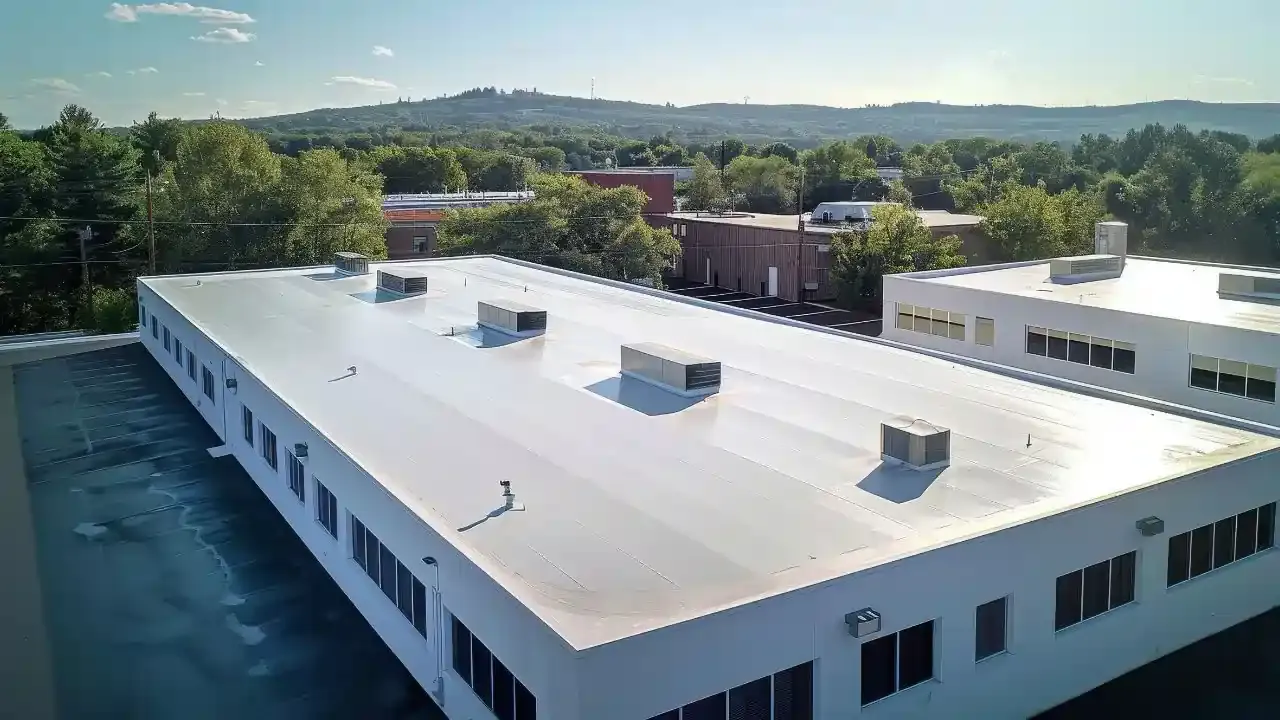
The flex building never roofs like the lease plan says it does
A flex building in Wilmington is whatever its tenants need it to be this lease cycle. One bay runs a marine fabrication shop feeding the boatyards along the Cape Fear River; the next holds a film-equipment vendor staging gear for a EUE/Screen Gems Studios production; a third is a tech startup that built out a small lab. The roof above all of them is one continuous low-slope membrane, and it has to keep performing while the uses underneath it churn. We roof these buildings around that reality, not around the original architect's drawings.
Most of our flex work clusters in the corridors where this building type actually sits: the Dutch Square and Corporate Drive industrial pockets off Market Street, the warehouses feeding the Port of Wilmington along Burnett Boulevard, the Highway 421 industrial belt running north toward the Pender County line, and the converted light-industrial buildings in the Cargo District south of downtown. These aren't uniform. A 1980s tilt-wall on Corporate Drive carries a tired built-up roof; a metal building near the port runs an R-panel roof that has lost its fastener gaskets. The reroof spec has to start from what is actually up there.
Penetrations are the whole story on a multi-tenant roof
The defining problem with flex space is that every tenant improvement punches the membrane. New occupant brings in a packaged rooftop unit, runs a refrigerant line set, adds an exhaust fan over a paint booth, drops a conduit for new power. Over fifteen years a flex roof accumulates dozens of penetrations that exist nowhere in the property records. Half of them were flashed by whoever the last tenant hired in a hurry. So before we price anything we walk the roof and build a penetration inventory: every curb, pipe, drain, and conduit photographed, located on a plan, and graded for condition.
That survey is where leaks hide. A field membrane in fair shape can still soak insulation for years through one abandoned curb that a vacating tenant capped with a sheet of plywood and a tarp. On the Cape Fear coast, where wind-driven rain comes sideways off the Atlantic and a tropical system can dump several inches in an afternoon, those half-sealed penetrations fail fast. We seal, re-flash, or remove every one of them as part of the scope so the new warranty actually means something.
Membrane choices for tilt-wall and metal flex
For concrete and tilt-wall flex buildings, our default is a 60-mil TPO mechanically attached over tapered polyiso. The taper matters here because old flex roofs almost always pond, drains were set for the original layout and the insulation has compressed unevenly under years of foot traffic from HVAC techs. Where a building carries dense rooftop equipment or sees heavy service traffic between tenant units, we step up to 80-mil TPO or a fully adhered 60-mil PVC for the extra puncture and grease resistance.
Pre-engineered metal buildings are a different decision. If the standing-seam or R-panel roof still has structural life, a coated metal recover or a retrofit framing system over the existing panels can extend service life without a tear-off and without disrupting the tenants below. We core and probe the assembly first to confirm there is no trapped moisture in the existing insulation before recommending a recover over a full replacement.
Vacancy is when flex roofs get hurt
Lease transitions are the riskiest moment for a flex roof. A tenant pulls out, their rooftop unit comes off, and the open curb sits exposed until the next buildout, often months. Our turn inspections for landlords and property managers confirm every curb cap, verify former-tenant penetrations are permanently sealed rather than tarped, and clear the drains, because vacant bays collect leaves and debris far faster than occupied ones. Catching that during a vacancy is the difference between a flashing repair and a deck replacement.
How we work with owners and property managers
Flex space in Wilmington is mostly held by investors and managed by third parties, so our coordination starts with a bay-by-bay occupancy map and a single point of contact in property management. We identify which units have live rooftop equipment, which are vacant, and which tenants are noise- or downtime-sensitive, then sequence tear-off and daily dry-in around that. Tenants get advance notice through the manager, crews don't field calls from individual units. Pricing is fixed per roofing square after a walk and core samples, and portfolio owners get standardized condition reports they can roll into capital planning across multiple buildings.
Industrial Flex Space Roofing questions
How do you handle undocumented tenant penetrations?
We photograph and map every roof penetration during a pre-project survey, compare it to original construction documents where they exist, and flag any non-standard or improperly sealed penetration for remediation before new membrane goes down. That inventory becomes part of your closeout file and prevents warranty disputes later.
What membrane is best for a multi-tenant flex building?
For tilt-wall and concrete decks in Wilmington, 60-mil TPO mechanically attached over tapered polyiso is the cost-effective default. Buildings with heavy rooftop equipment or frequent service traffic justify 80-mil TPO or fully adhered 60-mil PVC for better puncture resistance.
How do you coordinate work across tenants with different schedules?
We build a bay-by-bay occupancy map with property management, identify active rooftop equipment and noise-sensitive tenants, and sequence the work around that. Daily dry-in is confirmed before crews leave, and tenant communication runs through the property manager rather than directly with the crew.
Do you handle metal roofs on pre-engineered flex buildings?
Yes. We evaluate standing-seam and R-panel roofs for coated-metal recover or retrofit framing versus full replacement, based on panel condition, purlin spacing, and trapped-moisture testing. We spec and install both approaches.
How is the work priced for investors?
Fixed price per roofing square after a roof walk and core samples, based on membrane spec, deck condition, penetration density, and bay configuration. Portfolio owners receive standardized condition reports for capital planning across buildings.