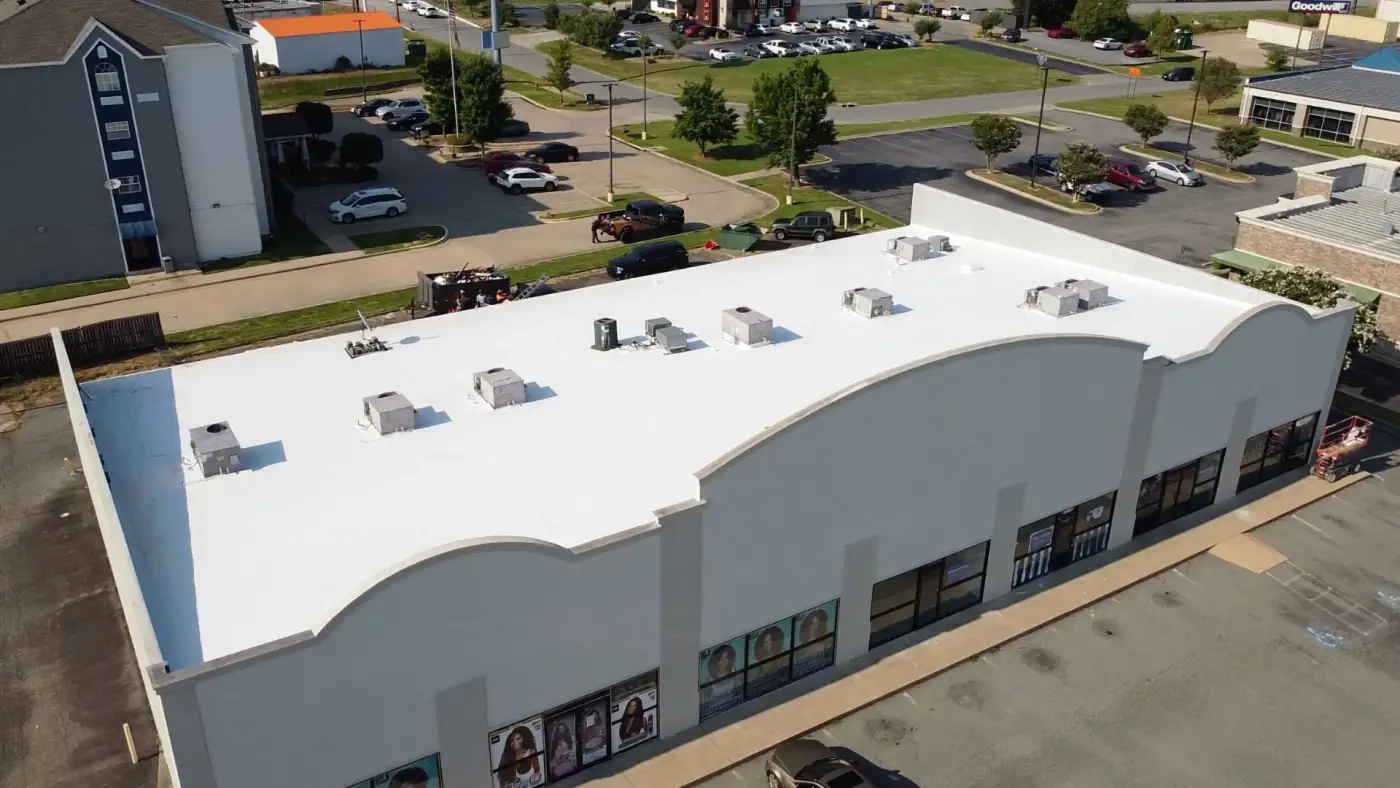
Full roof tear-off and replacement activity in the Wilmington commercial market surged after Hurricane Florence in September 2018 and remained elevated for years afterward. Florence's combination of Category 1 wind damage and catastrophic multi-day rainfall across New Hanover and Brunswick counties produced widespread commercial roof failures, torn membranes, stripped edge metal, saturated insulation on a scale that made recover or restoration inadequate for hundreds of commercial buildings. Dorian in 2019 added to the replacement workload before the Florence-driven projects were fully completed. The volume of post-storm commercial roof replacement activity in the Wilmington market over the past decade has shaped how commercial property owners here think about roofing, not as a long-cycle capital expense to be deferred indefinitely, but as a building system with a real service life that needs to be planned for and replaced on an informed schedule.
Full tear-off begins with the decisions that precede it: confirming that tear-off is the right call rather than a recover, and establishing an accurate scope of what is being removed. We verify existing layer count, conduct infrared scanning to assess insulation moisture, and core-sample to check deck condition before finalizing the project scope. On Wilmington commercial buildings where chronic moisture infiltration has been occurring, the tear-off sometimes reveals deck deterioration that was not apparent before the membrane was removed, rotted wood decking, corroded metal deck, or delaminated concrete deck that has been exposed to water migration through failed insulation for years. Finding deck problems during tear-off is better than discovering them during a future inspection, but it means the project scope and budget need to accommodate deck repair or replacement before the new system is installed. We communicate deck findings immediately when they are discovered and present options for addressing them before proceeding.
Debris management is a logistics challenge on commercial tear-off projects in Wilmington that varies significantly by building type and location. Large industrial buildings in Northchase Industrial Park and the Port of Wilmington corridor produce enormous quantities of tear-off material, a 100,000-square-foot warehouse with two layers of membrane and insulation generates hundreds of tons of roofing debris that must be staged in dumpsters, loaded, and hauled to disposal facilities. We plan dumpster placement and truck routing to minimize interference with facility operations, coordinate with building managers around loading dock schedules and material delivery access, and manage the debris removal pace to keep the work area organized and the building protected as tear-off progresses across the roof field.
Historic downtown Wilmington commercial buildings present entirely different tear-off logistics. Narrow streets, historic facades, neighboring buildings in close proximity, and the absence of large staging areas make debris management in the downtown core more complex than an industrial site. We use appropriately sized equipment, smaller dumpsters positioned to preserve pedestrian and vehicle access, protected chutes when debris must be lowered from multi-story buildings, and careful material handling to prevent debris contact with historic facades and neighboring structures. Work hours may be restricted by city ordinance or building owner preference to minimize disruption to downtown businesses and residents. We plan these projects with logistics detail that reflects the specific constraints of the urban historic environment.
Deck preparation before new insulation and membrane installation is a critical phase that determines the new system's long-term performance. Any deck substrate that has been damaged by moisture, wood decking with soft spots or delamination, metal deck with surface rust that compromises fastener pullout strength, concrete deck with spalled or deteriorated surface, must be addressed before the new system is installed on top of it. We clean the deck surface thoroughly, treat metal deck with rust-inhibiting primer where surface oxidation is present, replace wood decking sections where rot is found, and verify fastener pullout strength in the deck before designing the new insulation attachment. A new roof installed on a compromised deck has a service life limited by the deck below it, not the membrane on top.
New system selection on replacement projects follows the same assessment protocol as any roofing project, building type, exposure, drainage configuration, budget, and energy performance requirements. Post-Florence and post-Dorian replacement projects in the Wilmington market have produced a noticeable shift toward systems with better wind uplift resistance than the systems they replaced. Commercial property owners who experienced membrane loss or edge metal failure in those storms are motivated to upgrade to systems that perform better under the conditions that caused the prior failure. Upgrading from ballasted EPDM to fully adhered TPO, from standard R-panel metal to standing seam, or from a mechanically attached single-ply to a fully adhered system is a common and sensible post-storm replacement decision when the insurance proceeds or capital budget permit the upgrade.
Insulation specification on replacement projects is the right time to address both energy code compliance and thermal performance optimization. North Carolina's energy code (ASHCEA 90.1) specifies minimum R-values for commercial roof insulation in Climate Zone 3, where Wilmington is located. Many older commercial buildings in the Wilmington market have insulation below current code minimums, both because codes have increased over time and because some original construction was below code even at the time. A replacement project that brings insulation to current code levels or better is an investment in the building's ongoing energy cost performance, and the incremental cost of upgrading insulation thickness during a tear-off project is modest compared to the lifetime energy savings the additional R-value delivers in Wilmington's cooling-dominated climate.
Phased replacement on occupied commercial buildings keeps the building watertight throughout the project. Rather than stripping the entire roof at once, which would leave the building unprotected, we work in sections: tear off a section, install new insulation and membrane, complete flashings and transitions to the adjacent existing roof section, then move to the next section. Phased work extends the project timeline compared to a full-building simultaneous tear-off, but it is the correct approach on occupied buildings where weather exposure of the interior is not acceptable. We plan section sizes based on the crew's daily production capacity relative to weather forecast windows, completing each section to a watertight condition before end of day or before a forecast rain event.
Post-replacement documentation includes a complete photographic record of pre-existing conditions, deck findings, new insulation installation, membrane installation, flashing details, and final completed conditions. This documentation package serves as the warranty registration baseline, the insurance pre-storm documentation for the new system, and the starting point for the building's maintenance record under the new roof. We provide the complete documentation package to the building owner at project completion and retain copies in our project file for our maintenance program clients.
Questions Owners Ask
How do I know when my commercial roof needs full replacement versus a repair or recover?
Full replacement is typically the right answer when: insulation moisture is widespread (more than 25 percent of the roof area), the building already has two existing roofing layers (IBC limit), the deck has structural deterioration that needs to be addressed, or the existing system has reached the end of its design life and repairs are becoming more frequent and expensive than systematic replacement. We conduct a thorough assessment including infrared scanning, core sampling, and layer count verification before recommending replacement versus lower-cost alternatives.
How long does a commercial roof replacement take on a typical Wilmington building?
Project duration depends on roof size, building type, system being installed, and weather. A 15,000-square-foot retail or office building typically takes one to two weeks for a complete tear-off and replacement. A 75,000-square-foot industrial building may take three to five weeks with phased work. Post-storm projects in the Wilmington market sometimes face extended timelines due to material lead times when regional demand is elevated after a major hurricane event, planning ahead when possible avoids the delays that come with emergency demand conditions.
Should I upgrade my roof system when I replace it, or just replace in kind?
Replacement is the right time to evaluate upgrades. The incremental cost of upgrading to a better system at replacement time is far lower than retrofitting after a new system has been installed. In Wilmington's coastal market, upgrades worth evaluating include: moving from R-panel to standing seam metal (eliminates exposed fastener vulnerability), upgrading from ballasted to fully adhered single-ply (improves wind uplift performance), adding tapered insulation for positive drainage (eliminates chronic ponding), and increasing insulation thickness above code minimum (improves energy performance for the life of the system). We present upgrade options with cost-versus-benefit analysis on every replacement project.
What happens if the tear-off reveals deck damage that was not expected?
We document the discovery immediately with photographs and measurements, stop work in the affected area, and contact you directly to discuss the findings and options. Deck repair or replacement must be completed before new insulation and membrane can be installed, proceeding over a compromised deck is not something we will do. Scope and budget for deck repair are addressed as a change order to the original project. We price deck repairs transparently and present options when multiple repair approaches are viable.
My building's roof was replaced after Hurricane Florence using insurance proceeds, but I'm not sure the contractor did the work correctly. Can you assess it?
Yes. Post-storm replacement quality concerns are something we hear regularly in the Wilmington market, the surge of demand after major storms brings contractors with limited experience into the market, and installation quality varies. We can conduct an independent assessment of the replacement work, including seam quality testing, flashing detail inspection, drainage verification, and documentation review. If we identify installation deficiencies, we can help you understand your options for addressing them under the prior contractor's workmanship warranty or through other channels.