Airport terminal and aviation facility roofing in Wilmington, NC starts with an understanding that these structures can't follow a standard commercial timeline. Wilmington International Airport (ILM), serves coastal North Carolina with American, Delta, and United regional service, operates around the clock, and every work access point, material lift, and crew deployment must be coordinated with the airport's facilities department, the FAA Part 139 safety program, and in some cases TSA security protocols. We build that coordination into the project scope before the contract is signed, not after mobilization.
ILM's terminal expansion and the Wilmington area's hurricane-exposure coastal construction environment create consistent demand for wind-rated and storm-hardened commercial roofing throughout New Hanover and Brunswick counties.
Secondary and Reliever Airports Serving Wilmington:
- Cape Fear Regional Jetport (SUT), general aviation in Oak Island south of Wilmington
- Raleigh-Durham International Airport (RDU), major hub 130 miles northwest
The roofing systems on airport terminals and aviation support structures carry requirements beyond standard commercial membranes. Jet blast exposure on airside roofs requires membrane adhesion and ballast specifications that exceed what you'd specify for a comparable logistics building. HVAC systems on terminals are denser and heavier than standard commercial, requiring a higher number of curbed penetrations and more frequent flashing maintenance touchpoints. Terminal roofs often span long, flat expanses with minimal slope, which means drainage design is critical and ponding tolerance is near zero. We've done this work, and we don't learn those lessons on your project.
Aviation-adjacent commercial roofing, cargo facilities, rental car centers, FBO hangars, aircraft maintenance facilities, hotel structures on airport campuses, presents a different set of challenges than the terminal building itself, but the airport coordination requirement doesn't go away. Our crews understand that badging and security access at any part of an airport campus is non-negotiable and is planned for, not discovered onsite.
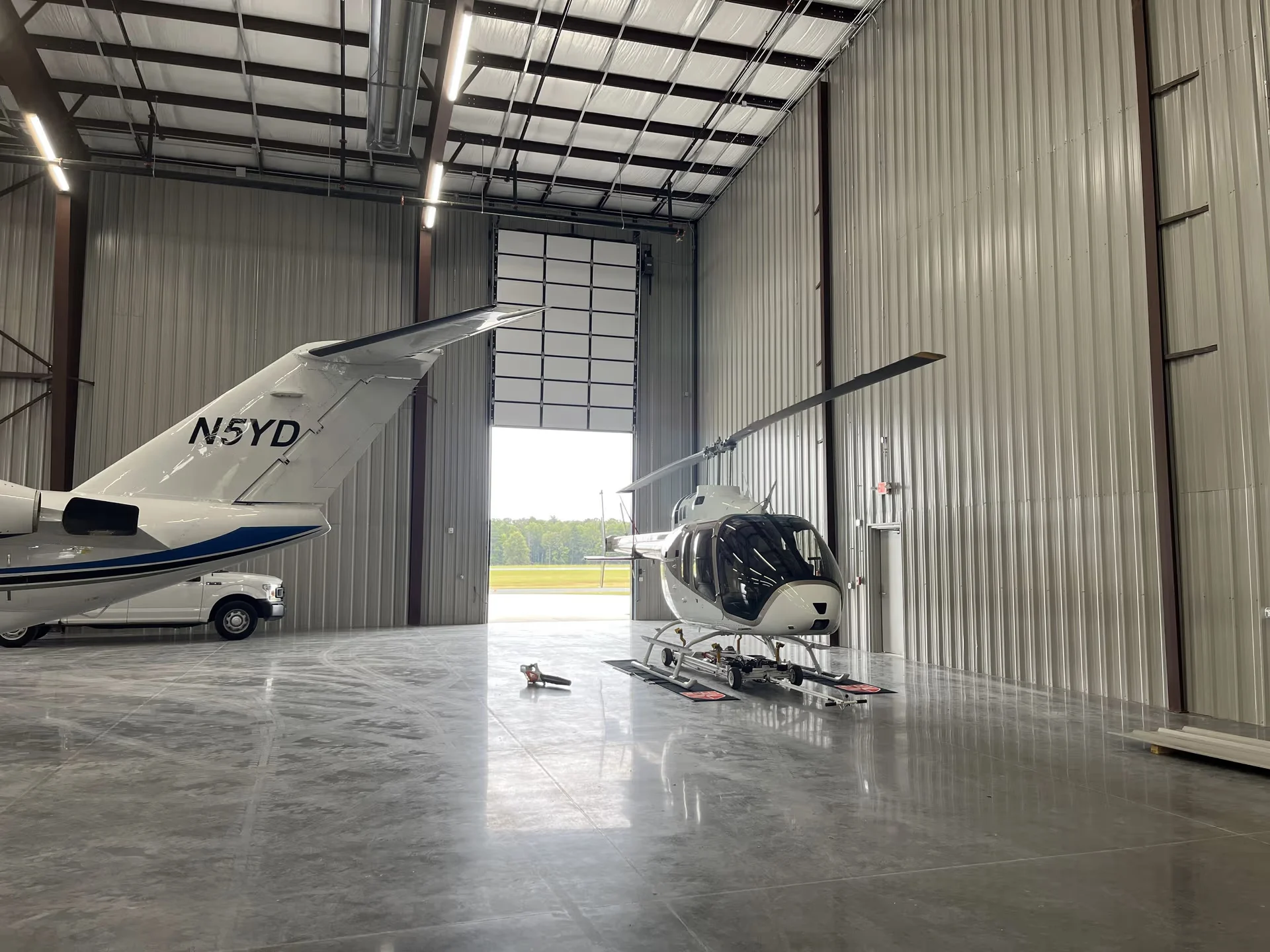
For general aviation facilities, FBOs, private hangars, and reliever airport structures, the security protocols are less intensive but the building type is often more demanding. High-bay hangar structures with large clear-span roofs require specific fastening patterns and seam geometry to handle the wind uplift loads these buildings generate. We spec and install those systems in Wilmington and throughout NC.
Operational details that change the roof plan
Airport Terminal & Aviation Facility Roofing work has to be sequenced around the activity under the roof. We review loading areas, customer or patient access, tenant hours, rooftop equipment, fire lanes, interior leak history, and any areas where noise, odor, debris, or temporary closures would create problems for the building.
Those constraints change quickly across Wilmington. A roof near Port of Wilmington may need different staging than a roof near Pender Commerce Park, while coastal exposure near Oleander Drive can move edge metal, drainage, and temporary dry-in higher on the priority list.
The finished scope has to be usable by more than one person. We write the findings so facility teams can understand the active roof condition, property managers can coordinate occupants, and ownership can separate urgent leak control from longer-term capital work without guessing what the field notes mean.
Before work starts, we also flag the assumptions that affect price and disruption: fall protection, material staging, interior protection, temporary dry-in, waste handling, and the roof areas where deck or insulation conditions may change the recommendation after investigation.
We keep that decision record attached to the roof area instead of burying it in a generic estimate. If ownership chooses a repair path, the record shows what was intentionally left for later maintenance. If the building needs capital planning, the same notes become the starting point for alternates, phasing, exclusions, and the schedule constraints that affect final pricing.
That is also where communication gets practical: who can approve a change, when the roof can be opened, which entrances or loading areas have to stay clear, and what photos or notes need to be captured before the work is closed out.
When those details are settled early, pricing conversations are cleaner and the roof work is less likely to turn into an emergency change order.
That record also gives managers a clear baseline for the next inspection cycle.
- Map the roof into work zones that match access, safety, and building operations.
- Flag roof areas where wet insulation, ponding, traffic paths, or equipment curbs change the budget.
- Keep the scope usable for ownership, facility teams, property managers, and bid reviewers.
Airport & Aviation Roofing Questions
How do you handle project scheduling at an operational airport like Wilmington International Airport?
We work with the airport facilities department and FAA Part 139 coordinator to develop a phased work plan approved by airport operations. Material deliveries, crane lifts, and any work near airside areas are scheduled during approved windows and coordinated with the FAA NOTAM process if required. We've done this at multiple airports and it's a standard part of our project setup, not an exception.
What roof systems are standard for large-span airport terminal roofs?
Most terminal re-roofing in Wilmington uses a TPO or PVC single-ply membrane on a tapered insulation system designed to improve drainage and address ponding. For new high-bay aviation structures and hangars, standing seam metal is often specified. The selection depends on the existing deck, load capacity, and operational constraints, we develop a spec after walking the roof with your facilities engineer.
How do you deal with the density of HVAC and mechanical penetrations on airport terminals?
Terminal HVAC density is significantly higher than standard commercial. Our pre-project survey documents every penetration, curb height, and mechanical clearance before we develop the work plan. Flashing details for oversized equipment curbs and complex through-penetrations are engineered individually, we don't use standard residential-pattern flashing details on aviation structures.
Can you work on airside structures (cargo aprons, gate structures near active runways)?
Yes, with appropriate badging and in full coordination with airfield operations. Airside work requires a higher level of pre-planning and crew credentialing, which we factor into the bid timeline. We do not mobilize crew members without confirmed airside authorization, that's a baseline requirement we enforce, not a favor we ask.
Do you handle hangar roofing for FBOs and general aviation facilities?
Yes. General aviation hangar roofing, whether for a single-bay private hangar or a multi-unit FBO complex, is a regular part of our commercial project mix in Wilmington. High-bay hangars with wide-flange steel or pre-engineered building systems require roofing contractors who understand those structures' specific uplift and thermal movement characteristics. We do.