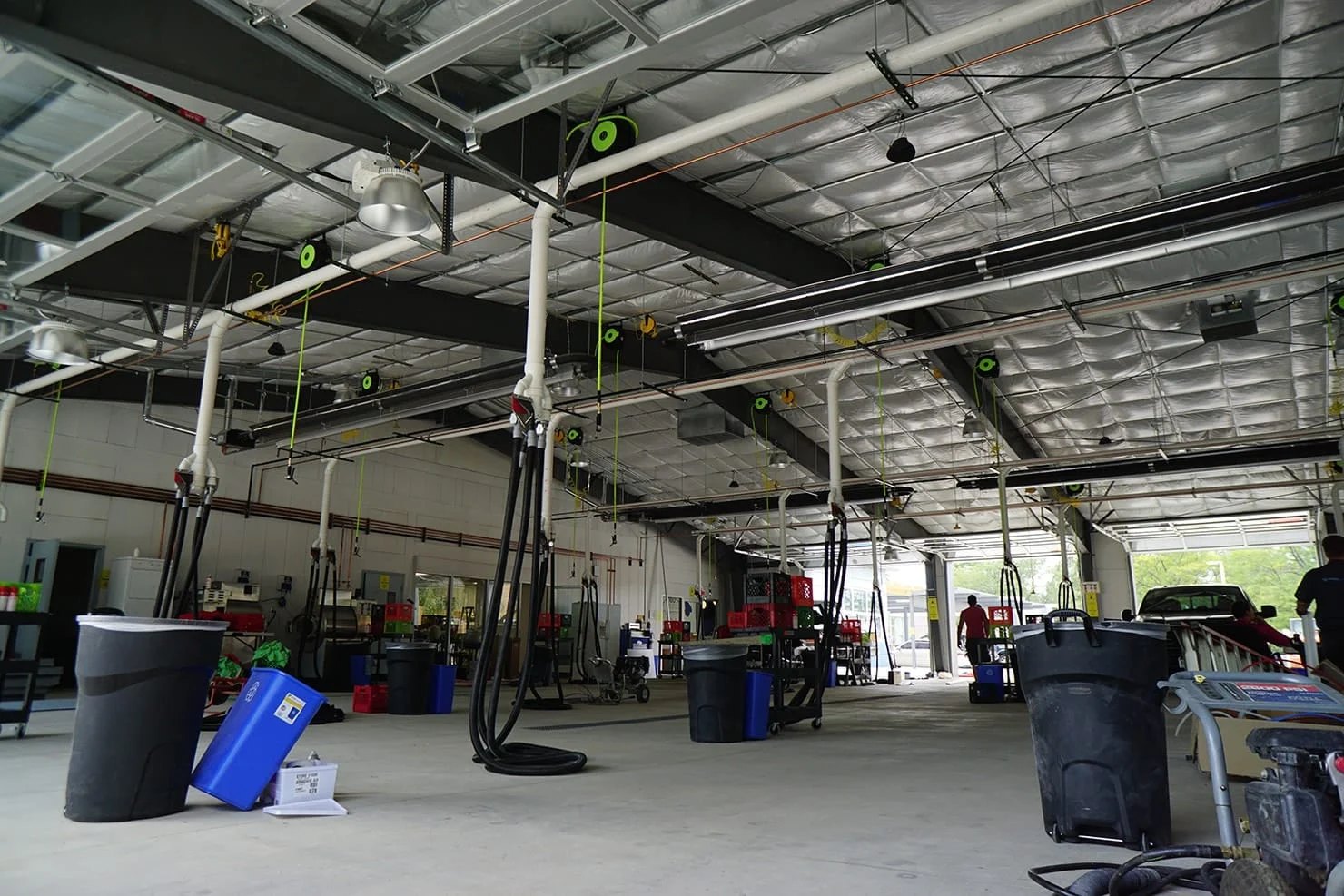
A car wash is the only commercial building we work on where the roof is attacked from underneath. Inside an active tunnel, hot water, foaming detergent, tire dressing, drying agents, and wax become a fine airborne mist that rises straight to the deck. It condenses on the underside of the steel, drips back onto fasteners, and works into seams from a side no roof inspector ever photographs. Wilmington has added express tunnels fast over the last several years, along Oleander Drive, up Market Street toward Ogden, around Monkey Junction, and across the river in Leland off US-17, and we get calls on a lot of roofs that were spec'd as if they sat over a dry retail box. They don't last.
Why Wilmington car wash roofs fail early
Two forces stack here. The first is the wash chemistry itself: the alkaline detergents and solvent-based dressings used in a full menu wash are corrosive to bare steel deck and to the coating on most fasteners. The second is the Cape Fear coast's own humidity. We sit in a hot, salt-laden marine climate where the air outside is already wet for much of the year; add the interior steam load of a tunnel running open hours a day and the dew point inside the building rarely drops. The deck never gets a chance to dry out. That is the combination that rusts fastener heads, blisters field membrane, and rots the wood blocking at the perimeter long before a standard 20-year roof should show wear.
We also see a lot of vapor-drive damage with no visible leak. A wash bay can have water staining and corroded purlins overhead while the surface membrane still looks fine from a drone pass. That is why we core the deck on every existing car wash before we quote a recover, a recover over a saturated, corroding assembly just buries the problem for two more years.
The wash bay is its own roof
We treat the tunnel or active bay as a separate roof zone from the equipment room, the customer lobby, and the cashier canopy, because the exposure is completely different. Over the bay we lean toward a thicker PVC membrane, fully adhered. PVC holds up to the alkaline detergent and wax load far better than TPO or EPDM, whose chemistries break down faster under the same vapor. Fully adhering it also kills the membrane flutter that tunnel blower pressure causes and eliminates the fastener field that vapor would otherwise corrode from below. Before we name a product we get the actual chemical program off the operator, the brand and dilution of detergent, dressing, and drying agent in use, and confirm it against the manufacturer's chemical-resistance guide. Two washes a mile apart can need two different specs.
Underside protection and ventilation
On a re-roof we want to interrupt the vapor before it reaches the deck. That can mean an air-barrier and vapor-control strategy on the interior side, upgraded coated or stainless fasteners, and confirming the bay's exhaust is actually moving the steam out rather than letting it stratify against the underside of the roof. If the mechanical contractor's exhaust is undersized, the best membrane on the market will still sit over a wet deck.
Canopies, vacuums, and the in-between zones
Most Wilmington washes are not a single rectangle. There is the tunnel, a pay-station canopy, a long run of vacuum canopies on the exit side, and the transitions where each of those ties back into the main structure. Those tie-ins are where we find the chronic leaks. Vacuum canopies take tire-dressing overspray and exhaust, they thermal-cycle hard in the full coastal sun, and their drain connections and counterflashing at the building wall get neglected. We scope the canopies, their gutters and downspouts, and every canopy-to-building flashing as discrete line items, not as an afterthought to the main roof.
Penetrations built for steam
The high-volume exhaust fans that pull steam off the tunnel sit on curbs that see constant warm, chemical-laden airflow. A standard pre-fab pipe boot does not survive there. We oversize the curbs, use welded membrane flashings rather than mastic, and detail each penetration to the equipment actually sitting on it.
Working around a wash that never closes
Express washes in this market run seven days a week, and a closed bay is lost revenue the operator feels immediately. We sequence around that. Tunnel-roof work goes in the early-morning or late-evening window when the bay is down; the equipment room, lobby, and canopy work can run during open hours with the crew staged so cars are never near the lift or the debris path. We confirm a watertight dry-in before every close so an afternoon thunderstorm off the Atlantic never reaches the wash equipment overnight.
Car Wash Roofing Questions
What membrane do you specify over an active wash tunnel?
Usually a 60-mil or thicker PVC, fully adhered. PVC resists the alkaline detergents and wax compounds in a commercial wash far better than TPO or EPDM, and adhering it removes the corrodible fastener field and stops blower-pressure flutter. The equipment room, lobby, and canopies can run a more standard mechanically attached system since their exposure is lower.
Does the wash chemistry void a standard roofing warranty?
It can. Most single-ply warranties carry a chemical-exposure exclusion. Before we spec the bay we confirm the operator's actual detergent and dressing program against the manufacturer's chemical-resistance data and pursue a chemical-duty or extended warranty where the maker offers one for car wash conditions.
My membrane looks fine but the deck is rusting. Why?
That is classic underside vapor damage. The steam and chemical mist inside the bay condense against the deck and corrode it from below while the top surface still looks serviceable. We core the deck and run a moisture survey before any recover, because covering a corroding assembly only delays a tear-off.
Can you keep the wash open during the work?
Yes, with sequencing. Tunnel-roof work goes in the pre-open or post-close window; canopy and support-building work runs during business hours with traffic kept clear of the staging zone. We confirm a watertight dry-in before each evening close.
Do you also handle the vacuum and pay-station canopies?
Yes. Canopy membrane or panel replacement, gutters and downspouts, and every canopy-to-building transition are scoped as their own line items. On Wilmington washes those tie-ins are the most common source of recurring leaks.