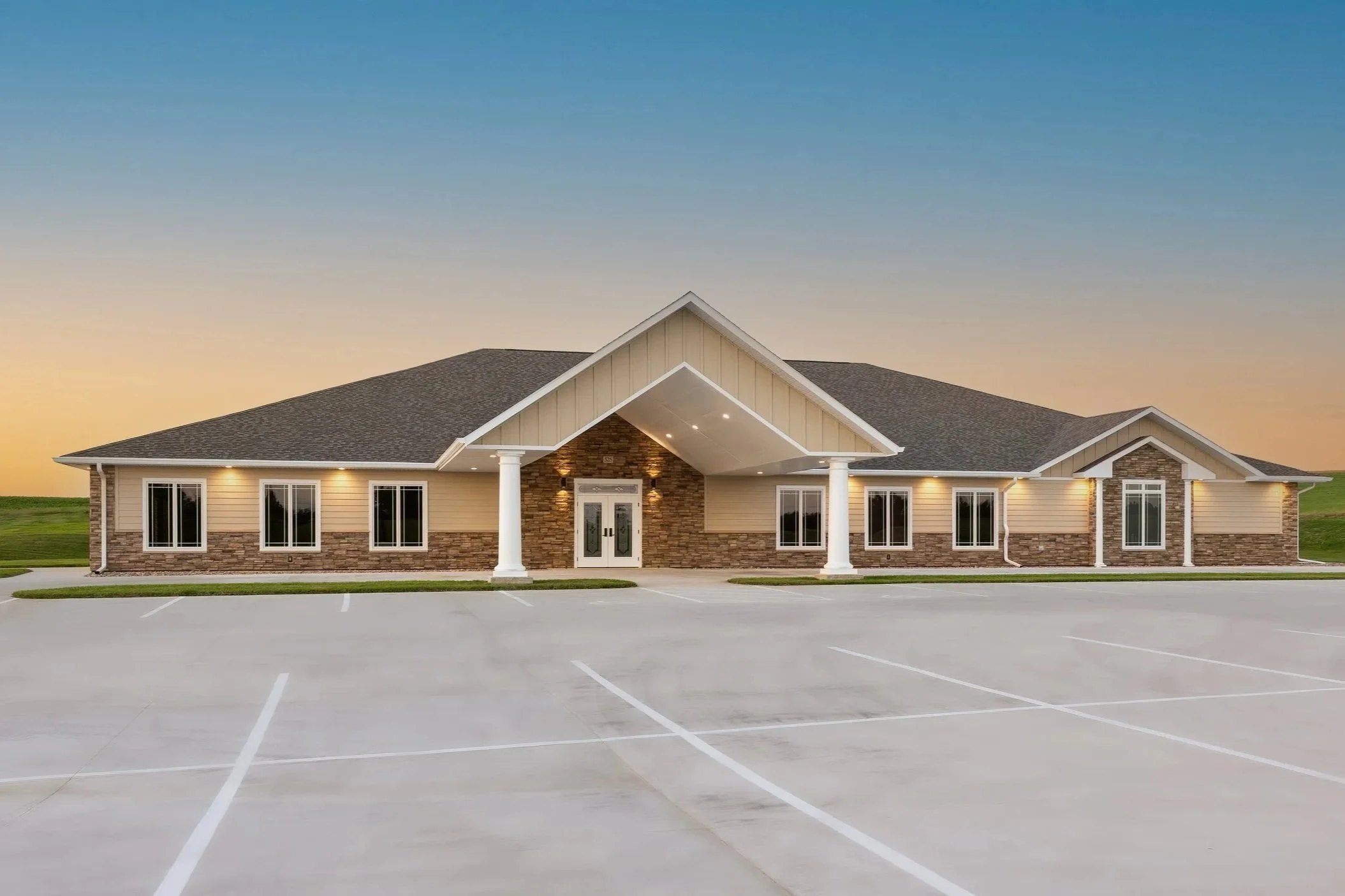
A funeral home is one of the few buildings where the way the roofing work feels to the people inside matters as much as how the roof performs. Families come in on the hardest days of their lives, and the last thing they should notice is a crew. These buildings are never really empty, visitation runs into the evenings most days of the week, services can be scheduled on short notice, and the preparation room operates on the timing of death calls rather than a construction calendar. Wilmington's funeral homes range from long-established chapels in and around the historic district and along Market Street to newer facilities out the South College Road and Shipyard Boulevard corridors, and several are multi-generational family businesses that have anchored their neighborhoods for decades. We treat the work with the same occupied-building discipline we bring to a hospital, and with discretion on top of it.
Scheduling around services, not around us
The funeral director's calendar runs our schedule. We ask for advance notice of services and visitations and sequence the work so active areas are quiet and protected when families are present, no noise, no crew, and no equipment near the chapel or the primary entrance during service hours. We confirm a watertight dry-in before the facility closes each evening so an overnight storm off the coast never reaches the interior, and we keep our staging and access out of the spaces families move through.
The preparation room exhaust stays running
The embalming and preparation area is the one technical constraint that overrides convenience. These rooms hold strong negative pressure to contain formaldehyde and other chemical vapors, and the rooftop exhaust serving them has to keep running continuously to stay within OSHA requirements. We locate that exhaust stack before mobilization, plan the flashing around it as its own scope item with the director's sign-off, and confirm the exhaust stays in operation during any work near the stack. It is never capped, blocked, or taken offline to make the roofing easier.
Chapel spans and aging assemblies
Chapel and visitation rooms are often built like small sanctuaries, clear spans of 40 to 60 feet with no intermediate columns. Those spans generate real wind-uplift loads, and on this hurricane-exposed coast the fastening pattern and membrane spec have to be engineered to the deck and span rather than assumed. Many of the older funeral homes in Wilmington's established districts carry decades-old built-up roofing on wood or concrete decks. Before we recommend a recover on one of those, we core-sample and run a moisture survey, because wet insulation hidden under a surface membrane that still looks presentable is common on these buildings, and recovering over it just buries the failure.
A roof that looks the part
Appearance is part of the work here in a way it is not on a warehouse. The visible roof edges, the fascia and gutters, and the entry canopy are part of how the building presents to a grieving family, so we hold the sheet-metal and edge details to a finished standard, not a utilitarian one.
Porte-cochere and covered entries
Almost every funeral home has a porte-cochere or covered entry where families are received and processions stage. Those canopy-to-building transitions and their drainage connections are a classic source of chronic leaks on older facilities, and they are right over the most visible, most-used part of the property. We evaluate the porte-cochere and covered entries as discrete scope items in every inspection and detail the tie-in flashings and canopy drainage so the leak does not come back over the front door.
Systems and ownership
For flat-roof sections we generally specify a 60-mil membrane over tapered polyiso, using the taper to correct the drainage deficiencies and standing water that age out low-slope roofs on older buildings. Over wood-decked chapels we confirm load capacity before setting insulation thickness. Owners here come in two forms, independent family operations and regional chains with corporate facilities management, and both want the same things: a quiet, dignified job, a schedule that respects services, and a contractor who understands the regulatory and community expectations on a building families depend on. That is how we approach every funeral home.
Quiet maintenance that prevents the emergency
The roof problem a funeral home cannot afford is the one that surfaces during a service, a ceiling stain in the chapel, a drip in the visitation room, a bucket where families gather. A modest maintenance plan prevents almost all of that. We inspect the membrane, flashings, and drainage on a regular cycle, clear the gutters and the porte-cochere drains that clog with leaves and Spanish moss off the live oaks common in older Wilmington neighborhoods, and reseal the small details before they open up. Catching a tired flashing in a scheduled visit is quiet and cheap; chasing a leak over the chapel during a Saturday service is neither.
Storm readiness on the coast
Hurricanes and tropical systems reach Wilmington, and a funeral home has to be presentable and functional on short notice no matter what blew through. We offer priority emergency response and dry-in for the facilities we maintain, so a damaged roof is secured fast and the building is ready to receive families again as quickly as possible. Edge metal, fascia, and canopy attachment are detailed to coastal wind standards so the most visible parts of the building hold up when a storm comes ashore.
Funeral Home & Mortuary Roofing Questions
How do you work around services and visitations?
The funeral director's weekly calendar drives the schedule. We take advance notice of services and visitations and sequence work so active areas are quiet and protected during them, with no crew or equipment near the chapel or main entrance during service hours. Dry-in is confirmed before the facility closes each evening.
What about the preparation room exhaust?
It stays running. Prep-room exhaust must operate continuously for OSHA compliance, so we locate the stack before mobilization, plan its flashing as a separate scope item with the director's approval, and confirm continuous operation during any work nearby. It is never blocked or taken offline for convenience.
What membrane do you specify for a funeral home?
For flat-roof sections, generally a 60-mil membrane over tapered polyiso. The taper corrects the drainage deficiencies common on older buildings and clears the ponding that ages out a low-slope roof. On wood-decked chapels we confirm load capacity before setting insulation thickness.
Can you handle a clear-span chapel roof?
Yes. Chapel roofs span like small sanctuaries and generate real uplift on this coast. We evaluate the deck type, span, and existing attachment and engineer the fastening and membrane spec to it, with pull-out testing or structural documentation where needed.
Does the porte-cochere get included?
Yes. The porte-cochere and covered entries are scoped as their own line items. Their canopy-to-building transitions and drainage connections are a common source of chronic leaks over the most visible part of the property, and we detail those tie-ins specifically.