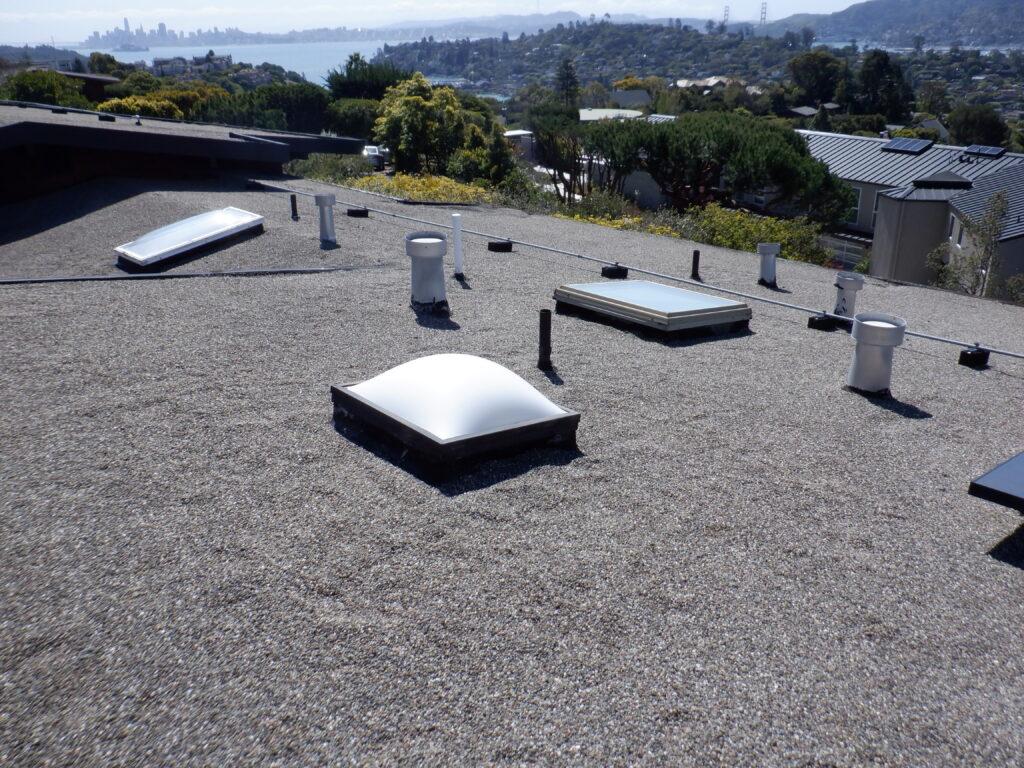
One building, several roofs, several owners of the risk
A mixed-use building is really three or four buildings stacked on each other, and the roofing reflects that. Shops at the street, offices or apartments above, sometimes parking tucked into the base, and a finished plaza or amenity deck somewhere in between. Each use keeps different hours, carries different mechanical loads, and answers to a different party when something leaks, the retail tenant, the condo association, the developer's warranty. The roofing scope has to read the building vertically, deciding where standard low-slope membrane ends and where occupied-deck waterproofing begins, and then tie the whole thing together so no seam between systems becomes the gap nobody warrantied.
Wilmington has been building exactly this. The Riverfront and downtown blocks around Front and Water Street have filled in with ground-floor retail under apartments. Mayfaire blends shops, offices, and residential along Town Center Drive, and the Cargo District and Soda Pop District south of downtown have turned old warehouses into mixed retail-and-residential adaptive reuse. Brunswick County's growth corridors are adding ground-up mixed-use as the metro spreads across the river. None of these is a single flat roof, and pricing them as one is how warranty gaps get built in.
The podium deck is waterproofing, not roofing
The most misunderstood plane in a mixed-use building is the podium, the deck between retail or parking at grade and the residential or office floors above, often finished as a courtyard, plaza, or planted amenity space. People bid it as flat roofing and it fails inside five years. A podium carries pedestrian and sometimes vehicle traffic, constant hydrostatic pressure under planters, root pressure from landscaping, and structural deflection from the occupied floors above. That demands a traffic-bearing waterproofing assembly with drainage composite, root barrier, and protection course, coordinated with the structural engineer on the load path, not a single-ply membrane meant for maintenance foot traffic. We separate these two scopes deliberately and spec each for what it actually carries.
Upper floors: parapets, penthouses, and amenity decks
The roof over a residential tower is its own set of details. Parapet drainage on a tall building, flash-through at the mechanical penthouse, waterproofing under rooftop amenity decks, and clean transitions at elevator overruns and mechanical-room enclosures all have to land correctly. Wilmington's coastal wind exposure raises the stakes at every parapet and edge, uplift at a tall building's corners is severe, and the edge metal and membrane termination have to be engineered for it. Rooftop amenity decks get the same traffic-bearing assembly logic as a podium: a waterproofing layer under the finish surface, installed in coordination with the deck-finish contractor, never a bare membrane meant to be walked on by maintenance only.
Warranty coordination is the real deliverable
On a mixed-use building the hardest part isn't any single membrane, it's making the warranties line up. Different assemblies from potentially different manufacturers meet at the podium-to-tower transition, the parking-to-retail edge, the planter perimeters. If those interfaces aren't detailed and documented, a leak at a transition becomes a finger-pointing exercise between two valid warranties that each exclude the seam. We map every system boundary up front, detail the transitions so one party owns each interface, and register the warranties so the developer, the association, and the retail owners each hold coverage that actually closes at the lines between them.
The maintenance handoff matters as much as the install. A mixed-use building rarely has a single party walking the whole roof, the residential association watches its tower, the retail owner watches the storefront block, and the podium often falls to whoever drew the short straw. We leave a roof zone diagram that labels each system, its warranty term, and who carries it, so the next leak gets routed to the right contractor and the right coverage instead of stalling between parties. On the Cape Fear coast, where a single tropical system can test every transition on the building in one afternoon, that clarity is the difference between a same-week repair and a season of arguments.
Building around occupied retail and residents
These projects are rarely empty. Reroofing or repairing a mixed-use building usually means working over a leasing office, a coffee shop, and occupied apartments at the same time. We build a phasing plan before mobilizing: noise, vibration, and dust containment; confirmed daily dry-in in writing before crews leave; and elevator and common-area access coordinated with building management so residents and retail traffic aren't trapped behind the work. Downtown Wilmington's noise rules and tight urban sites factor into the working hours and staging from day one.
Working inside the construction team
On new and renovation mixed-use work we operate inside the project team, coordinating with the general contractor, the MEP subs, the structural engineer, and the building-envelope consultant at once. That means living inside the submittal process: manufacturer technical approval of each specified system, waterproofing mock-ups and testing before full installation, quality-control inspections at the critical phases, and manufacturer-rep sign-off feeding into NDL warranty registration at closeout. Lenders and developers expect that paper trail on a mixed-use building, and we produce it from pre-construction through final inspection.
Mixed-Use Development Roofing questions
What's the difference between roofing and podium waterproofing?
Roofing membranes handle low-slope drainage and maintenance foot traffic. A podium deck carries pedestrian or vehicle loads, hydrostatic pressure under planters, root pressure, and structural deflection, it needs a traffic-bearing waterproofing assembly with drainage composite and root barrier. Using a standard membrane on a plaza or amenity deck typically fails within five years.
How do you coordinate work over occupied retail and residential?
With a detailed phasing plan set before mobilization: noise, vibration, and dust containment; daily dry-in confirmed in writing; and elevator and common-area access coordinated with building management so residents and retail tenants aren't disrupted.
Do you handle rooftop amenity decks?
Yes. Amenity decks need a traffic-bearing waterproofing assembly under the finish surface, installed in coordination with the deck-finish contractor and the structural engineer of record, not a standard roofing membrane.
How do you keep the warranties from leaving gaps at transitions?
We map every system boundary up front, detail each transition so one party clearly owns it, and register the warranties so the developer, association, and retail owners hold coverage that closes at the interfaces rather than excluding them.
What documentation do developers and lenders require?
Architect-reviewed submittals, manufacturer technical approval of the specified systems, mock-up testing before full installation, QC inspection reports, manufacturer-rep inspections at critical phases, and NDL warranty registration at closeout. We work inside that framework throughout.