A cinema roof is one long bridge over a dark room
Strip away the marquee and a movie theater is a structural problem: a series of big black boxes that have to span eighty to a hundred and fifty feet with no column in the middle of anyone's sightline. That clear span is the first thing we account for. A deck carrying that distance deflects and flexes under wind and live load in ways a short-span retail roof never does, so the fastening pattern and insulation attachment get specified to the actual deck depth and gauge, not borrowed from a strip-center detail. Get that wrong and the seams over the auditorium are where the membrane starts to fatigue.
Wilmington has a real cinema footprint to work in. The multiplex anchoring Mayfaire Town Center off Military Cutoff, the Monkey Junction screens serving the south-side growth corridor, and the independent and arthouse rooms downtown each present a different deck and a different age of roof. And this is a film town, between Cinespace and the legacy EUE/Screen Gems Studios soundstages, the line between a working production set and a public auditorium isn't always wide, and both want the same thing from a roof: a quiet, watertight box.
Acoustics live in the roof assembly
Sound is part of the spec on a cinema, and the roof is part of the sound. A thin, lightly built deck telegraphs rain drumming, jet noise off the Wilmington International Airport approach, and a passing thunderstorm straight into a quiet scene. Where acoustic performance matters, the mass and buildup of the roof assembly, the deck, the insulation layers, the cover board, all contribute, and we keep that in mind when we choose a recover over a tear-off or specify added insulation. We also avoid creating new flanking paths: a sloppy curb or an open chase between auditoriums can carry sound from one screen into the next as easily as it carries water.
The mechanical cluster rivals a hospital
Each auditorium runs its own air handling, because you can't share a return between rooms showing different films at different volumes. Stack that against concession exhaust, lobby heating vents, and condensers for the walk-in coolers feeding the food service, and the penetration cluster over a multiplex looks more like a data center than a retail box. Every curb, duct boot, and conduit gets flashed and documented individually before new membrane covers it, and we add reinforced walkway pads on the routes service crews actually use so foot traffic doesn't wear through the field near the units.
Decks, drainage, and what's really up there
Cinemas are usually steel deck or concrete over structural steel. Steel takes mechanical attachment directly, with fastener density set to the rib depth and confirmed by pull-out testing, older short-rib deck holds far less than modern three-inch rib. Concrete decks point toward adhered systems where the structure allows. On any reroof we start with a core sample to read the existing insulation layers, check moisture content, and get the real weight-in-place before we recommend a recover versus a full tear-off.
Drainage is the quiet killer on flat theater roofs. Decades of compression and re-roofing leave the field ponding where the original drains no longer sit at the low point. Our default reroof for a multiplex here is a 60- or 80-mil TPO mechanically attached over tapered polyiso, where the taper rebuilds positive drainage and the white membrane meets the cool-roof energy code most reroofing permits now require. On the Cape Fear coast that drainage work also matters for storm survival, a tropical downpour finds ponded low spots first.
Marquees, canopies, and the front of the house
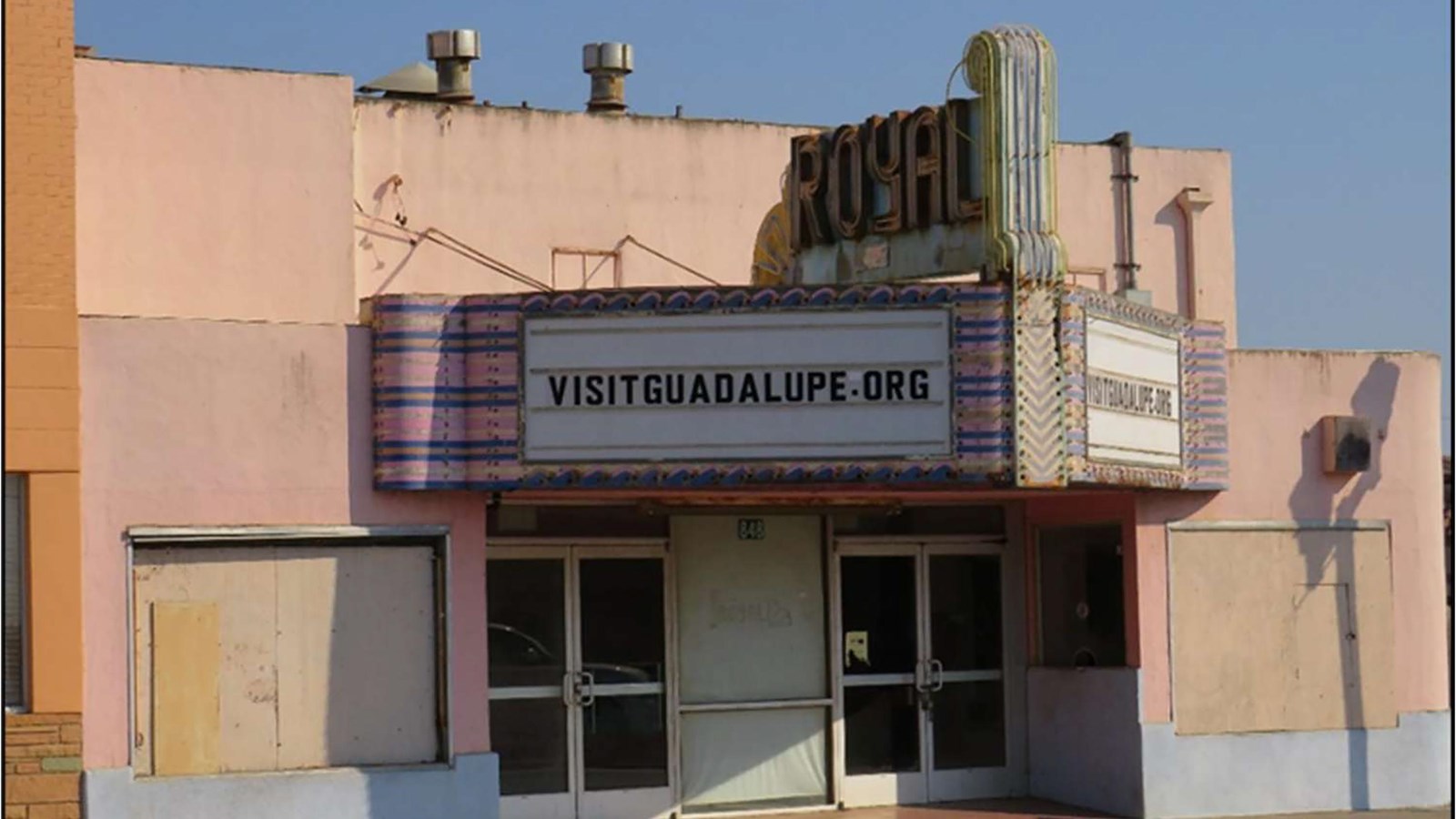
The marquee and the entry canopy are chronic leak sources on older theaters. Anywhere a sign support or canopy framing penetrates the membrane, we treat it as its own flashing item, and we re-flash the canopy-to-wall transition where differential movement has opened the original detail. These connections at the front of the house leak quietly into lobbies and box offices for years before anyone connects it to the roof.
Working around the show
Cinemas run afternoons through late night, every day, which puts them on the same footing as a 24-hour building for scheduling. We sequence tear-off and dry-in so every roof section is watertight before evening screenings, and we coordinate any HVAC shutdown windows for curb work with facilities management. Loading-dock access for vendors and evening foot traffic near the entries are built into the work plan, not discovered on day one. Pricing is fixed per roofing square after a walk and core review, and most multiplex reroofs include the tapered insulation design that pays for itself by ending the ponding.
Movie Theater & Cinema Roofing questions
What membrane do you specify for a multiplex?
Typically 60- or 80-mil TPO mechanically attached over tapered polyiso. The taper corrects decades of accumulated ponding, and white TPO meets the cool-roof energy code most reroofing permits now apply. We add reinforced walkway pads on service routes near rooftop units.
How do you handle the long auditorium spans?
We verify deck type and gauge before specifying mechanical attachment, with fastener density matched to the rib depth and confirmed by pull-out testing. Where deflection is a concern we may use an adhered or hybrid system to avoid concentrating point loads at the seams.
Can the work be done without disrupting screenings?
Yes. We plan around the screening schedule, sequence tear-off and dry-in so each section is watertight before evening shows, and coordinate any HVAC shutdown windows for curb and penetration work with facilities management.
How do you price a cinema reroof?
Fixed price per roofing square after a roof walk and core sample, based on membrane spec, deck and assembly condition, penetration density, and access. Most multiplex reroofs include tapered insulation to end ponding and extend membrane life.
Do you handle marquee and entry canopy connections?
Yes. Sign supports and canopy framing that penetrate the membrane are individual flashing items, and we re-flash the canopy-to-wall transition where differential movement has opened the original detail. These are a common source of chronic front-of-house leaks.