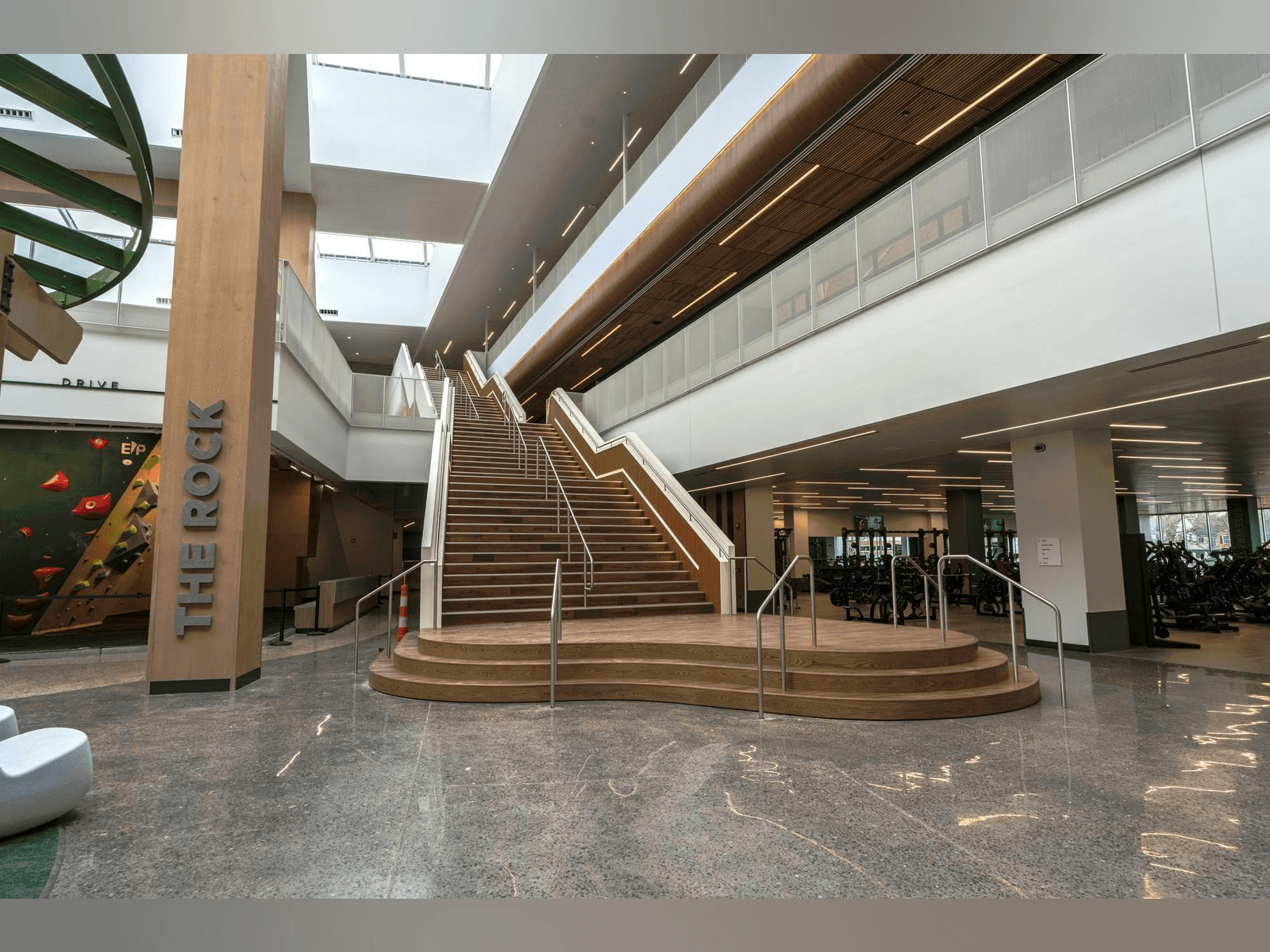
Recreation buildings break two roofing rules at once. They cover enormous open floors with no interior columns, and they pack the air underneath with heat and moisture from hundreds of people moving at the same time. A gymnasium roof can run 80 or 90 feet between supports; a natatorium roof has to live over a cloud of warm, chemically charged pool air. Wilmington has plenty of both, the city's recreation centers including the Martin Luther King Jr. Center, the New Hanover County parks and aquatic facilities, the YMCA, UNCW's Seahawk athletics venues, and a steady run of private fitness and court buildings along the Market Street and Military Cutoff corridors. None of them roof like a strip retail box, and we do not pretend they do.
Clear spans that deflect and lift
The long unsupported deck is the structural heart of a gym or court building. It deflects under load, it moves with temperature, and on this coast it takes serious wind uplift, Wilmington sits in a high-wind hurricane zone, so the uplift pressures at the corners and perimeter of a wide roof are not trivial. The fastening pattern has to be engineered to the real deck type and the real span. A steel deck carrying 80 feet needs different fastener pull-out math than the same deck at 30, and the perimeter and corner zones get a denser pattern than the field. We provide that deck evaluation and fastener layout as part of the scope rather than defaulting to a one-size pattern.
Humidity from the floor up
Hundreds of bodies in a gym, the showers off a locker room, and an open pool all push moisture vapor toward the deck. If the vapor retarder sits in the wrong plane for the climate, that vapor condenses inside the assembly and quietly soaks the insulation. This is where a generic detail copied from a dry climate goes wrong on the coast, the marine humidity here drives vapor differently, and the retarder position has to match Wilmington's actual conditions and the building's interior load. On any aquatic or high-humidity rec building we run a moisture survey before we finalize a recover scope, because recovering over a wet or misspecified assembly compounds the problem instead of fixing it.
Natatoriums are the hard case
An indoor pool is the most punishing roof environment in this category. Chlorine reacts with organic matter swimmers bring in and releases chloramine gas, which corrodes ordinary steel flashing, aluminum edge metal, and some membrane adhesives. Over a natatorium we move to stainless or copper flashing in the chloramine zone, confirm the membrane against the manufacturer's chemical-resistance data, and check that the ventilation actually exhausts pool air to the exterior instead of recirculating it against the underside of the deck. A pool hall roof that was detailed like a dry gym corrodes from the metal out.
System selection for big roofs
For most large-span gym and court roofs in Wilmington we lean on a 60-mil or 80-mil TPO mechanically attached over polyiso, with the attachment engineered to the deck and span. Where drainage is deficient we add tapered insulation to clear ponding, flat low-slope decks over big interior volumes are prone to it, and standing water plus our UV load shortens membrane life fast. Over a pool, material compatibility outranks the default spec, so the natatorium portion may carry a different membrane and flashing package than the dry gym next to it.
Programming and procurement
Rec facilities are busiest exactly when most crews want to be off the roof, evenings, weekends, and holidays. We schedule against the facility's program calendar: gym and court work concentrates in weekday daytime hours with a confirmed dry-in before evening programs start, and aquatic work coordinates with pool operations on any exhaust or HVAC penetration that could affect air exchange over the pool. The public side matters too. County, city, parks-department, and YMCA projects come with public-bid advertising, bid and performance bonds, and prevailing-wage rules where they apply; private clubs run a different procurement path but a similarly tight event calendar. We carry the bonding and insurance for public work in North Carolina and have worked both routes.
Rooftop HVAC sized for a full house
A recreation building's HVAC is built for peak occupancy, a packed gym during a tournament, a full group-fitness floor, a natatorium dehumidification system running hard, which means large rooftop units and heavy condensate loads sitting on a long-span deck. Those units concentrate weight, vibrate, and route condensate that has to drain without tracking back under the membrane. We confirm the deck carries the equipment before we add insulation, detail oversized curbs with welded flashings rather than mastic, and route condensate to a real drainage point. On a natatorium the dehumidification equipment is the single most important rooftop system, and its curbs and the duct penetrations around it get the stainless-grade treatment because they live in the chloramine plume.
Keeping a busy building dry mid-project
A wood-floor gym or a sprung athletic floor is ruined by a single overnight leak, so dry-in discipline is non-negotiable on these roofs. We open only what the crew can close the same day, confirm a watertight condition before evening programming, and stage materials so the floor below is never exposed to a Cape Fear thunderstorm. Protecting the asset under the roof matters as much as the roof itself on a recreation building.
Sports & Recreation Facility Roofing Questions
How do you keep pool and locker-room humidity out of the roof?
We set the vapor retarder in the correct plane for Wilmington's climate and the building's interior moisture load, and we run a moisture survey before finalizing a recover. Recovering over a wet or misspecified assembly only compounds the problem, so on any aquatic or high-humidity facility the survey comes first.
What flashing survives a natatorium?
Chloramine gas corrodes standard metal flashing, aluminum edge, and some adhesives. We specify stainless or copper flashing in the chloramine zone, confirm membrane compatibility against the manufacturer's chemical-resistance data, and verify the ventilation exhausts pool air outside rather than recirculating it against the deck.
Can you work around heavy evening and weekend programming?
Yes. We schedule against the program calendar, gym and court work in weekday daytime hours with a confirmed dry-in before evening programs, and aquatic work coordinated with pool operations on any penetration affecting air exchange over the pool.
Do you handle public bids for municipal rec centers?
Yes. County, city, parks, and school-gym work involves public-bid advertising, bid and performance bonds, and prevailing-wage compliance where applicable. We carry the required bonds and insurance for public work in North Carolina.
What system do you use for a large gymnasium roof?
Typically 60-mil or 80-mil TPO mechanically attached over polyiso, with the fastener pattern engineered to the actual deck and span and a denser pattern at perimeter and corner uplift zones. Tapered insulation is added where drainage is deficient.