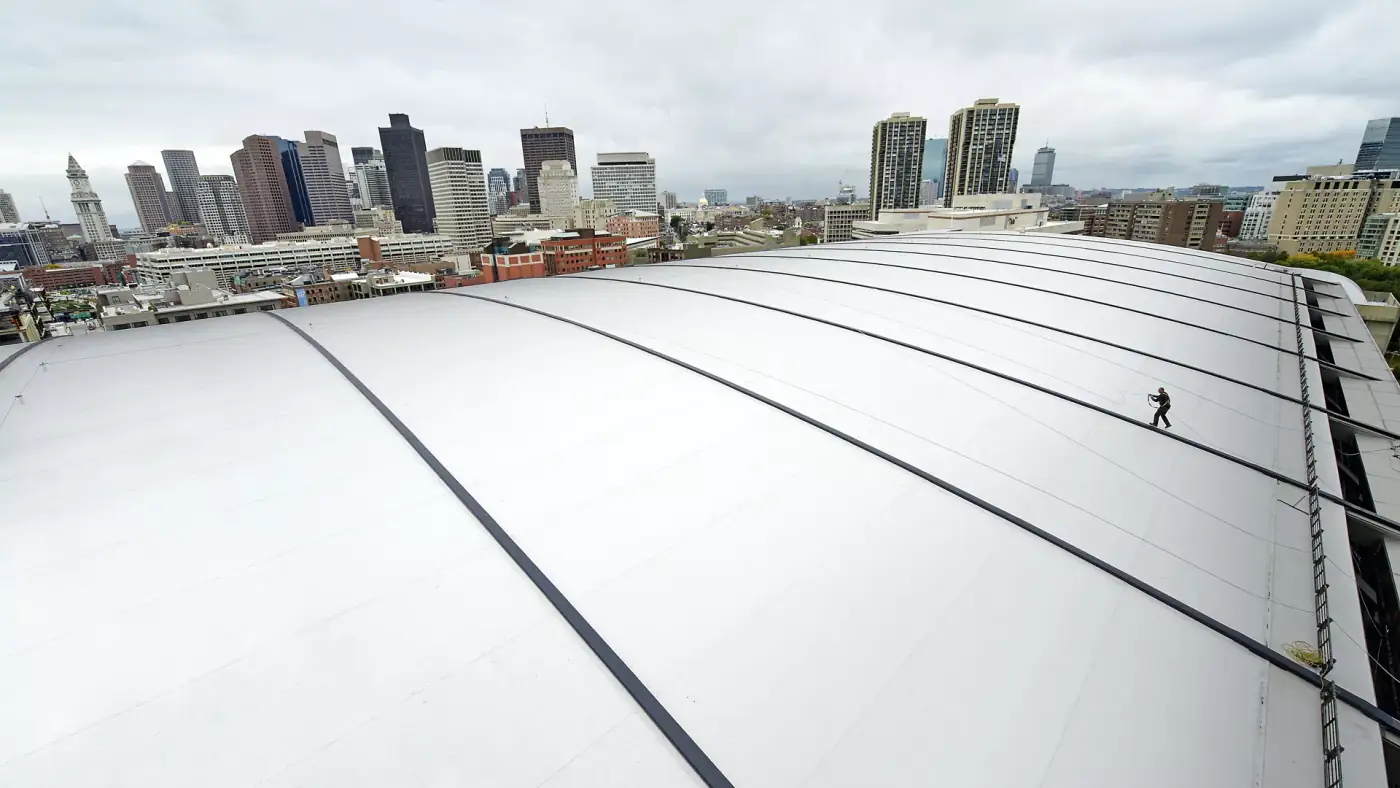
Wilmington's climate makes the cool roof argument straightforward. The city averages a 64.4°F mean annual temperature with summers that run hot and humid from May through September, the kind of sustained heat load that drives commercial HVAC systems to work hardest during the exact hours when Duke Energy Progress's demand charges are at their peak. A dark or aged commercial roof membrane on an uninsulated or under-insulated building can reach surface temperatures of 160 to 175°F on a clear July afternoon. That heat transfers into the building, raises interior temperatures, and forces cooling equipment to run longer and harder. A high-reflectance cool roof surface, whether a white TPO membrane, a silicone coating, or a reflective metal panel, brings that surface temperature down by 50 to 80 degrees and measurably reduces the heat transferred into the occupied space below.
The financial case for cool roofing in this market is most compelling for buildings with high cooling loads relative to heating loads. In Wilmington's humid subtropical climate, cooling dominates the energy budget for most commercial building types, retail, warehouse, light industrial, and hospitality. The heating season is mild and short. A reflective roof that reduces cooling load by 10 to 20 percent provides that savings every summer for the life of the system, with no recurring cost. On a 50,000-square-foot warehouse or retail building with a significant cooling bill, that savings is a meaningful annual return on the investment in a reflective membrane or coating system. Duke Energy Progress commercial rate structures include demand charges that amplify the value of peak load reduction, the hottest summer afternoons are exactly when demand charges accrue, and those are precisely the hours when a cool roof delivers the most benefit.
TPO membrane is the most common cool roof installation we perform on new construction and full replacement projects across Wilmington's industrial and commercial building stock. White TPO's standard reflectance of 0.80 or higher and thermal emittance approaching 0.90 qualifies it for ENERGY STAR certification and Cool Roof Rating Council listing without any additional treatment. For new construction in Northchase Industrial Park, ILM Business Park, Pender Commerce Park, and International Logistics Park, TPO is the default cool roof recommendation, it combines reflectivity with a fully heat-welded seam system that handles Wilmington's rainfall volume effectively, and it is available in membrane thicknesses from 45 to 80 mil that can be specified to match the building's traffic and durability requirements.
For existing buildings where the membrane is in serviceable condition but reflectivity has been lost through aging and weathering, silicone roof coatings provide the most practical path to cool roof performance without a full tear-off. A silicone coating applied at the correct mil thickness restores reflectance to near-new levels and adds the ponding water resistance that makes it particularly well-suited to Wilmington's post-storm drainage conditions. The coating application is far less disruptive to building operations than a full tear-off and replacement, and the installed cost is typically a fraction of full replacement, making the payback period on energy savings significantly shorter.
ENERGY STAR and Cool Roof Rating Council certifications matter for some commercial property owners beyond the energy savings alone. Buildings pursuing LEED certification or other green building recognition can credit qualifying cool roof installations toward their certification requirements. Institutional property owners, UNCW campus buildings, Novant Health facilities, municipal properties, increasingly have sustainability requirements that make certified cool roof systems a specification preference rather than just an option. We can provide product documentation, installed system specifications, and reflectance testing data to support certification applications for projects where that documentation is required.
Building envelope integration is a factor that affects how much benefit a cool roof actually delivers. A highly reflective roof on a building with poor insulation below the deck delivers less net energy benefit than the same roof on a well-insulated building, because the insulation layer determines how much of the reduced surface heat gain actually translates to reduced interior load. When we are replacing a full roof system, we evaluate insulation thickness and condition as part of the project scope, both because wet or deteriorated insulation needs to be replaced regardless, and because upgrading insulation thickness during a tear-off and re-roof is the most cost-effective time to do it. The combination of a reflective membrane and code-compliant or better insulation produces the best cool roof energy performance.
Maintenance of cool roof reflectance matters over time. A white TPO or silicone coating system that is allowed to accumulate biological growth, algae and mildew are common in Wilmington's warm, humid conditions, loses reflectance as the dark growth covers the white surface. We include reflectance maintenance as part of our commercial roof maintenance programs: periodic cleaning with appropriate biocidal agents that restore the reflective surface without damaging the membrane. Some silicone coating manufacturers include algaecide treatments in their coating formulations that slow biological growth, and we specify those products on coastal Wilmington projects where roof cleaning access is difficult or infrequent.
Metal roofing can serve as a cool roof system when the correct panel coating is specified. Standing seam metal panels with Kynar-coated finishes in light colors, white, light gray, or tan, achieve reflectance values comparable to TPO and are the preferred cool roof solution for coastal hospitality properties, restaurants, and commercial buildings where metal is the aesthetic and performance choice. The standing seam profile eliminates the exposed-fastener corrosion issue that limits R-panel metal in Wilmington's coastal environment, and the concealed-fastener system provides superior wind uplift resistance, both characteristics that make standing seam the right metal choice for coastal NC cool roof applications.
We conduct a post-installation energy performance review with commercial clients approximately one year after a cool roof installation to assess the actual measured benefit against pre-installation energy bills. This follow-up is useful for clients who want to document savings for internal reporting or for institutional energy management programs, and it gives us data on real-world performance in the Wilmington climate that we use to refine our recommendations for future projects. Cool roofing in coastal North Carolina delivers real, measurable financial returns, we are confident enough in that outcome to document it.
Questions Owners Ask
How much will a cool roof actually save me on energy costs in Wilmington?
Results vary significantly by building type, insulation level, HVAC system efficiency, and how much of the building is air-conditioned. For a warehouse or light commercial building with modest insulation and significant cooling load, 10 to 20 percent reductions in cooling energy are common after installing a high-reflectance membrane or coating. On a building spending $30,000 per year on cooling, that is $3,000 to $6,000 in annual savings. Duke Energy Progress demand charges mean the savings on peak summer days are proportionally higher than the straight energy reduction suggests.
Is there a difference between ENERGY STAR roofing and a standard white TPO membrane?
ENERGY STAR certification requires that a roofing product meet minimum initial and aged reflectance and emittance values as tested and verified by the Cool Roof Rating Council. Most commercial white TPO products from major manufacturers meet these thresholds. The ENERGY STAR label provides a third-party verified performance claim rather than a manufacturer's self-reported value. For projects where the certification documentation matters, LEED, institutional sustainability requirements, utility rebate programs, specifying ENERGY STAR certified products provides the documentation chain needed.
Can I get a cool roof on my existing building without replacing the whole membrane?
Yes, if the existing membrane is in sound condition with dry insulation beneath it. Silicone and acrylic roof coatings applied over existing TPO, EPDM, modified bitumen, or BUR membranes restore reflectance to high levels and add ponding water resistance. The key qualification is that the existing substrate must be assessed first, coating over a membrane with wet insulation or failed seams does not solve the underlying problems and produces a poor result. We conduct a thorough inspection and core sampling before any coating recommendation.
Does Duke Energy Progress offer rebates for cool roof installations?
Duke Energy Progress has offered commercial energy efficiency incentive programs that have included roofing upgrades at various points. Program availability and incentive amounts change, and we recommend contacting Duke Energy Progress directly or checking their current commercial efficiency program offerings when evaluating a cool roof project. We can provide the product documentation, reflectance ratings, ENERGY STAR certification, installed system specifications, needed to support a rebate application if a qualifying program is available.
How long does a cool roof coating maintain its reflectance in Wilmington's climate?
Silicone coatings maintain good reflectance for 10 to 15 years when properly maintained, but algae and mildew growth in Wilmington's warm, humid conditions can reduce effective reflectance within two to three years without periodic cleaning. We recommend biennial cleaning of cool roof surfaces as part of the maintenance program, it restores reflectance and extends the interval before recoating is needed. Some coating formulations include algaecide that slows biological growth between cleanings.