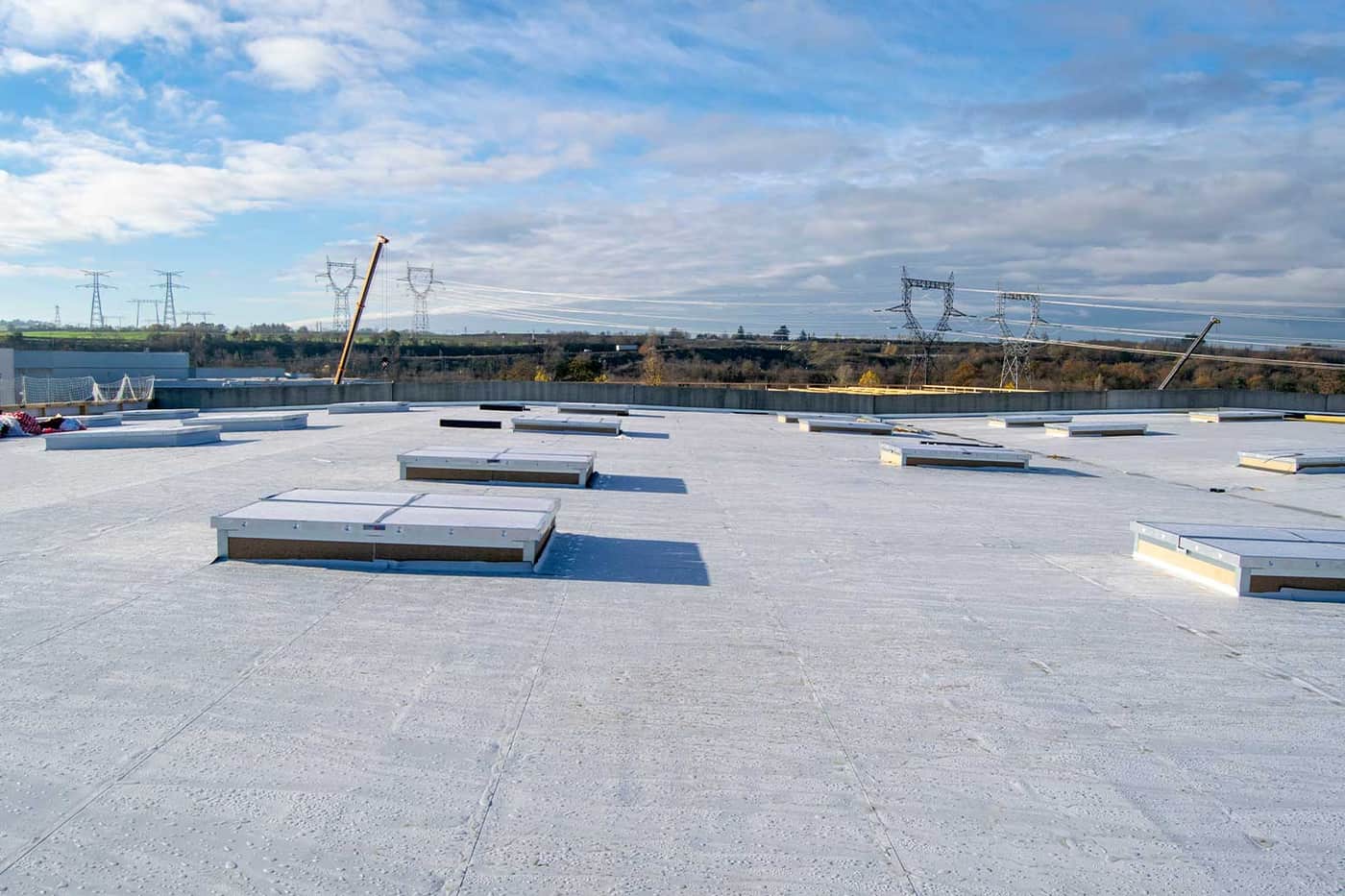
EPDM, ethylene propylene diene monomer, has been installed on commercial and industrial buildings across the Wilmington area for decades. It is a durable, cost-effective single-ply membrane with a long track record, and a significant portion of the existing commercial roofing stock in New Hanover and Brunswick counties is EPDM. That installed base creates a sustained need for EPDM expertise: seam repair, flashing replacement, recover decisions, and full tear-off and replacement on systems that have reached the end of their service life. We work with EPDM regularly and understand both its strengths and the specific ways it degrades in Wilmington's coastal environment.
UV exposure is the primary aging mechanism for EPDM membrane in the coastal Carolinas. Wilmington's latitude and the reflective amplification from water bodies, the Cape Fear River, the Intracoastal Waterway, the Atlantic, create UV intensity that accelerates surface oxidation of black EPDM faster than inland markets at comparable latitudes. An aged EPDM membrane in Wilmington develops surface chalking and micro-cracking at the field membrane, and, more critically, at the laps and seams where the membrane is adhered or tape-bonded. Seam integrity is the most important factor in EPDM's long-term performance, and UV-degraded lap adhesive or aged seam tape at a water-side or south-facing seam is a primary failure mode we diagnose consistently on older EPDM roofs in this market.
Salt air affects the metal components associated with EPDM installations in ways that are easily underestimated by owners managing their first coastal commercial building. Cover strips, termination bars, and edge metal details on EPDM roofs are typically aluminum, and in coastal Wilmington they corrode faster than the EPDM membrane itself. A termination bar that has corroded through at its fastener holes allows the EPDM base flashing to pull away from the wall, creating a water entry path at the perimeter that looks like a membrane failure but is actually a metal detail failure. When we assess older EPDM systems, we examine all metal termination components specifically, because replacing the membrane without replacing the corroded termination hardware produces a repair that fails prematurely.
Pipe boots and field penetration flashings on EPDM roofs are a consistent source of leaks, particularly on buildings with aging rooftop equipment that has been serviced multiple times over the years. HVAC technicians who do not specialize in roofing frequently damage EPDM around penetrations, stepping on clamped pipe boots, dislodging termination bars, and leaving gaps in flashings that are resealed with incompatible caulk. On buildings with significant rooftop mechanical equipment, industrial facilities, medical buildings, restaurant buildings, we find penetration flashing damage at a high rate during inspections. Replacing degraded pipe boots with correctly sized new EPDM boots, properly clamped and sealed, eliminates a disproportionate share of the leak sources on these buildings.
The recover versus tear-off decision on EPDM is driven primarily by the condition of the insulation beneath the membrane. Wilmington's rainfall volume means that any EPDM system with compromised seams or flashings has likely been admitting water into the insulation layer for some period before the owner noticed a ceiling leak. We use infrared thermal imaging and core sampling to assess insulation moisture content before recommending a recover. The IBC limits structures to two roofing layers, and many Wilmington commercial buildings are already at that limit. But even when an additional layer is technically permitted, recovering over wet insulation traps moisture in the assembly, degrades the new system's adhesion over time, and creates ongoing problems. We will not recommend a recover when moisture scanning shows significant wet insulation, the honest answer in that situation is a full tear-off regardless of the additional cost.
Port-area industrial buildings and warehouse facilities in Northchase and Pender Commerce Park often have large EPDM roofs installed in the 1990s and early 2000s that are now approaching or past their nominal 20-year design life. These roofs require honest assessment: some are performing adequately with targeted seam repairs and a reflective coating, while others have reached the point where field adhesion has failed broadly and the insulation has absorbed moisture to the extent that full replacement is the only viable path. We provide clear, photographic documentation of what we find and explain the options without steering toward the more expensive project when a targeted repair or recover is the right answer.
New EPDM installation on commercial buildings remains a competitive option in Wilmington's market. Fully adhered EPDM with 60-mil or 90-mil membrane thickness provides excellent performance on low-slope roofs with good drainage, and the material cost is generally lower than TPO or PVC for equivalent thickness. For budget-constrained projects where reflectivity is not a primary requirement, a building that is not air-conditioned, or one where the HVAC system is well-sized for the existing heat load, EPDM can deliver long service life at a lower installed cost than white single-ply alternatives. We specify EPDM on projects where it is the right material fit, not as a default or a cost-cutting shortcut.
Hurricane performance of EPDM systems depends heavily on the attachment method and the condition of the perimeter flashings. Fully adhered EPDM provides better wind uplift resistance than ballasted systems because the membrane is bonded across the entire field rather than held down only by the weight of ballast stones. Ballasted EPDM systems, common on some older commercial buildings in Wilmington, are at meaningful risk in hurricane-force winds, as ballast can be displaced and the membrane can lift, fold, and tear under sustained uplift. If you have a ballasted EPDM system in the Wilmington market, a pre-hurricane assessment of its attachment and perimeter condition is essential, and converting to a fully adhered or mechanically attached system should be seriously considered.
Warranty coverage on new EPDM installations is available from major manufacturers in terms ranging from 10 to 20 years, depending on membrane thickness, attachment method, and installer certification requirements. We maintain manufacturer certifications that allow us to offer warranted EPDM systems, and we complete the required documentation, thickness verification, lap inspection, and project registration, to ensure warranties are valid. In Wilmington's storm-active market, having a valid manufacturer warranty provides a layer of protection that a workmanship-only warranty from an uncertified installer cannot match.
Questions Owners Ask
How long does an EPDM roof last on a commercial building in Wilmington's climate?
A properly installed, well-maintained EPDM system typically delivers 20 to 25 years of service life. Coastal UV exposure, salt air on metal components, and Wilmington's high rainfall volume all work against that lifespan if maintenance is deferred. Buildings with regular inspection and prompt seam and flashing repairs consistently outlast those where maintenance is reactive. The insulation condition beneath the membrane is often the limiting factor, once insulation becomes significantly wet, the roof's remaining useful life is shortened regardless of the membrane's surface condition.
My EPDM roof is 18 years old and starting to leak at the seams. Is repair worthwhile or should I replace it?
At 18 years, an EPDM system is approaching the end of its design life, but the answer depends on the insulation condition and the extent of seam deterioration. If infrared scanning and core sampling show that the insulation is dry and the seam failures are localized, targeted seam repair or a restoration coating can extend the system's life cost-effectively. If the insulation shows widespread moisture absorption or the seam failures are distributed across the roof, a full replacement is the more economical long-term decision. We will tell you honestly which situation your roof is in.
Can I coat my existing EPDM roof to add reflectivity and extend its life?
Yes, with the right preparation. EPDM requires a specific primer before elastomeric or silicone coatings will adhere properly, the surface chemistry of EPDM is different from TPO and modified bitumen and does not accept coatings without priming. When the substrate is sound and the insulation is dry, a properly primed and coated EPDM system can deliver 10 to 15 additional years of service life while adding cool roof reflectivity. We inspect and core-sample before any coating recommendation to confirm the substrate qualifies.
How does salt air specifically damage EPDM Roofing components?
The EPDM membrane itself has reasonable resistance to salt air. The components that suffer most are the metal termination bars, cover strips, and edge metal associated with the system. These aluminum and galvanized steel components corrode faster in coastal environments, loosening their grip on the membrane edge and opening gaps that allow water infiltration at the perimeter and penetrations. Replacing corroded metal termination hardware is a standard part of any EPDM restoration or recover project we undertake in the Wilmington market.
Is ballasted EPDM a problem in hurricane country?
Yes. Ballasted EPDM relies on the weight of river-washed stone to hold the membrane in place, and that ballast can be displaced by hurricane-force winds, particularly at roof edges and corners where uplift forces concentrate. Once ballast is displaced, the membrane can lift, fold, and tear rapidly. We strongly recommend that owners of ballasted EPDM systems in New Hanover and Brunswick counties have their roof perimeter and attachment conditions assessed before each hurricane season, and we recommend considering conversion to a fully adhered or mechanically attached system on any building with significant storm exposure.