Hail damage to commercial roofs in the Wilmington area is a more common event than many building owners realize. While the Gulf Coast and interior Southeast produce the most severe hailstorms nationally, the Cape Fear region experiences convective storm activity each spring and summer that brings damaging hail to commercial properties across New Hanover, Brunswick, and Pender counties. Thunderstorm complexes moving off the Piedmont and through the Sandhills frequently intensify before reaching the coast, and afternoon sea-breeze convergence near Wilmington creates localized storm cells that can produce golf ball-sized hail with little warning. Industrial buildings in Northchase Industrial Park, Pender Commerce Park, and the International Logistics Park, with their large, flat, exposed roof areas, are particularly vulnerable because there is no tree canopy or neighboring structure to reduce hail exposure.
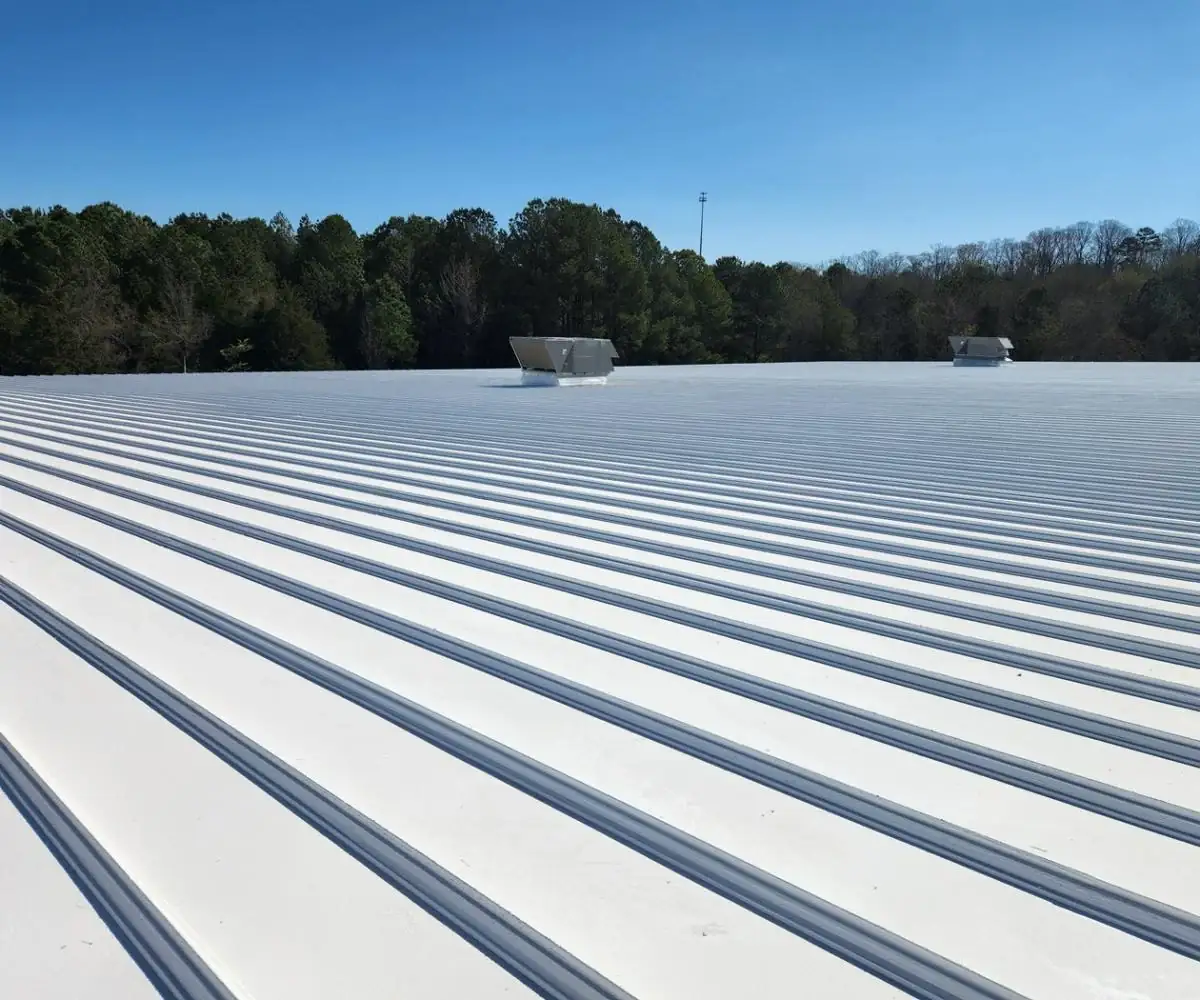
Hail damage to commercial roofing membranes is not always immediately obvious from the ground or even from a casual roof walk. TPO and EPDM membranes can sustain hail impact damage that creates micro-fractures or punctures not visible without close examination. Modified bitumen granule surfacing can be knocked loose by hail impacts, exposing the underlying bitumen to direct UV degradation, damage that accelerates membrane aging significantly even if water does not immediately infiltrate. Metal R-panel and standing seam roofing on industrial buildings shows cosmetic denting from hail that may or may not compromise the panel coating depending on impact severity. A thorough post-hail inspection requires getting on the roof and examining each section systematically, not a drive-by assessment from the parking lot.
Insurance documentation is the most time-sensitive part of hail damage restoration on commercial buildings. After a significant hail event, insurance carriers send adjusters to assess multiple properties simultaneously, and the documentation you provide at the time of the adjuster's visit significantly affects how the claim is evaluated. We respond quickly to post-hail inspection requests because the window between a hail event and adjuster visits can be short, sometimes as little than a week. Our inspection produces a written damage assessment with close-up photography of impact damage on each membrane type present, granule displacement measurements on modified bitumen surfaces, dent depth measurements on metal panels, and notation of any areas where immediate water infiltration risk exists. That documentation gives adjusters the information they need to properly scope the damage rather than minimizing it.
Distinguishing hail damage from pre-existing deterioration is a skill that matters enormously in the claims process. Insurance adjusters are trained to identify pre-existing wear and exclude it from storm damage claims. A commercial roofing contractor who can clearly document and articulate the difference between fresh hail impact points, which show specific impact morphology depending on membrane type, and pre-existing wear, granule loss, or UV degradation is a genuine asset to a building owner navigating a claim. We provide damage assessments that clearly distinguish storm damage from pre-existing conditions, and we can discuss our findings directly with adjusters when requested.
Industrial buildings in Northchase and Pender Commerce Park present a specific profile for hail damage assessment. These buildings are typically large-footprint, single-story structures with either TPO or EPDM membranes on flat or low-slope sections and exposed-fastener metal R-panel on higher-pitch sections or wall panels. Hail damage on TPO manifests differently than on metal, TPO shows impact craters and potential punctures, while metal shows denting and coating failure at impact points. A complete assessment addresses all roof system types present on the building and documents damage on each separately, since insurance claims for industrial buildings often involve multiple roofing systems that are evaluated differently by adjusters.
Restoration scope for hail-damaged commercial roofs ranges from targeted membrane patching on localized damage to full membrane replacement when impact damage is widespread across the field. For TPO and EPDM systems with isolated punctures and impact fractures, heat-welded or bonded patches over cleaned and prepared membrane surfaces provide effective repair when damage is limited. When hail impact density exceeds a threshold where patching becomes more expensive than replacement, or when the existing membrane was already near the end of its service life, full replacement is the more economical long-term decision. We present both options honestly when both are viable, with cost and longevity analysis for each.
Metal roofing hail damage assessment requires attention beyond the cosmetic denting that is visible from the surface. Hail impacts on R-panel metal can crack the panel coating at the impact point, exposing bare metal to the coastal salt-air corrosion environment. A panel with an intact coating on its surface is protected; the same panel with a network of hail impact coating cracks begins rusting from those points outward, and in Wilmington's coastal environment that corrosion progresses faster than it would inland. We assess panel coating integrity at impact points using close visual inspection and can provide coating repair or panel replacement as part of the restoration scope depending on the extent and severity of coating damage.
Timing of hail damage restoration matters in Wilmington's storm calendar. A commercial roof that sustains hail damage in April or May, common timing for spring convective storms, needs assessment and repair before hurricane season begins in June. Hail impacts that created micro-fractures in a membrane but did not immediately cause visible leaks can become active infiltration points under the sustained, wind-driven rainfall of a tropical storm event. We communicate urgency clearly when hail damage leaves a commercial building with membrane integrity compromised before hurricane season, a pre-existing hail vulnerability plus a direct storm hit is a combination that reliably produces significant water damage.
For portfolio owners managing multiple commercial properties across New Hanover and Brunswick counties, we offer post-hail event portfolio surveys, rapid triage inspections of all properties in the portfolio after a significant hail event to identify which buildings sustained damage, the severity at each, and the priority order for follow-up detailed assessment and repair. This service helps portfolio managers coordinate insurance reporting and repair scheduling efficiently rather than managing each property independently through the same process.
Questions Owners Ask
How do I know if my commercial roof was damaged by the recent hailstorm?
You may not be able to tell from the ground or without a trained eye on the roof surface. Hail damage to commercial membranes is often subtle, impact craters, micro-fractures, or granule displacement that is not visible without close examination. If your area experienced hail of one inch diameter or larger, a professional inspection is warranted. We respond quickly after hail events precisely because early documentation matters for insurance purposes.
Will my commercial property insurance cover hail damage to the roof?
Most commercial property insurance policies cover sudden and accidental hail damage. The claim process requires documenting that the damage was caused by the hail event rather than pre-existing wear. A detailed inspection report with photography, damage measurements, and a clear distinction between storm damage and pre-existing conditions gives adjusters what they need to properly evaluate the claim. We produce that documentation as part of every post-hail inspection.
How quickly do I need to file a claim after hail damage?
Commercial property insurance policies typically require prompt reporting of loss, most include notification requirements within a specified period after the event, sometimes 30 to 60 days. Beyond the policy requirement, earlier filing is strategically better: adjuster availability, contractor availability for documentation support, and the condition of the evidence are all better closer to the event. We recommend calling your broker and requesting an inspection within days of a significant hail event.
My TPO roof has some hail dents but no visible leaks. Does it still need repair?
Impact damage to TPO that does not immediately cause leaks may still have compromised membrane integrity at the impact points, micro-fractures that do not leak under normal rain but fail under the sustained hydrostatic pressure of heavy tropical rainfall or ponding. Pre-hurricane season is the wrong time to be operating a damaged membrane. We assess the actual impact depth and membrane integrity at each impact point and provide an honest evaluation of whether patching is warranted or whether the damage is cosmetic only.
Can hail damage to a metal roof cause long-term problems beyond the cosmetic denting?
Yes. Hail impacts can crack the protective coating on metal panels at the impact point, exposing bare steel to corrosion. In Wilmington's salt-air coastal environment, exposed metal at those impact points begins rusting faster than it would inland. If coating damage is extensive across a metal roof panel, rust propagation can compromise the panel's structural integrity over time. We assess coating integrity at hail impact points and recommend coating repair or panel replacement based on the extent of actual coating failure versus cosmetic denting that has not breached the coating.