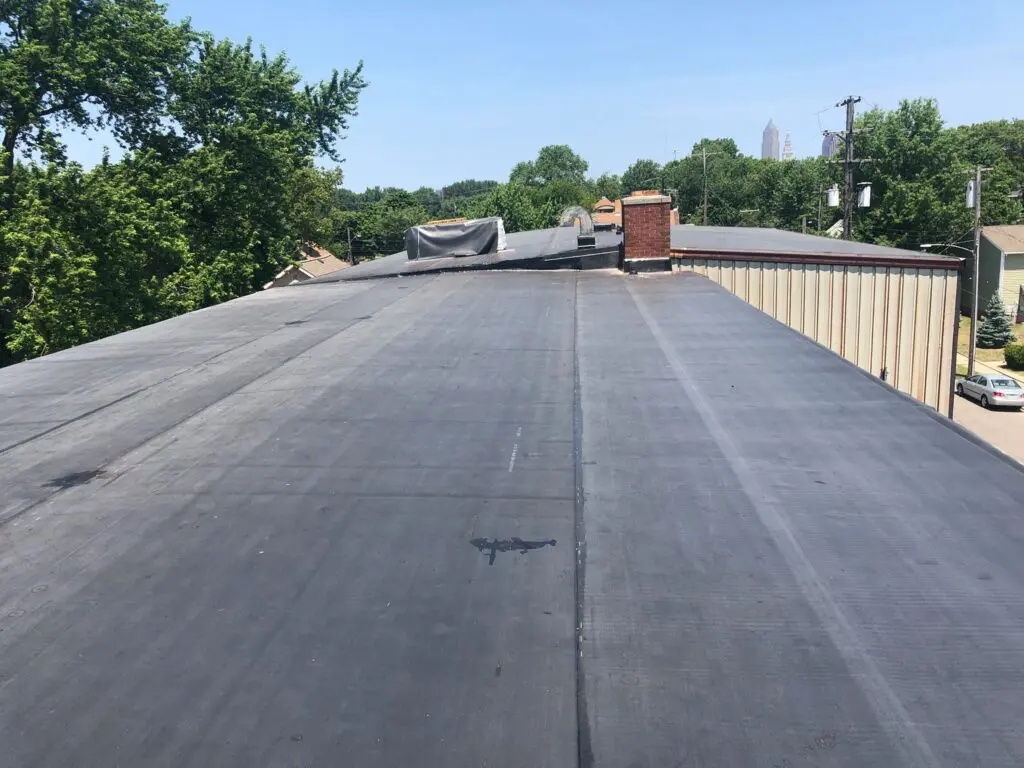
Modified bitumen roofing, both SBS (styrene-butadiene-styrene) and APP (atactic polypropylene) formulations, has been installed on commercial buildings across Wilmington since the 1980s and represents a significant portion of the existing flat roof stock in the city's older commercial corridors. Downtown Wilmington, the South Front District, the historic riverfront commercial buildings, and the older industrial buildings near the Port of Wilmington all have a meaningful concentration of modified bitumen systems, some of them original installations and some of them layered recoveries over even older BUR assemblies. Working with these systems, assessing them, repairing them, and deciding when they need to be replaced, requires understanding both the material and the buildings it is installed on.
SBS modified bitumen is the more flexible of the two formulations, modified with a rubber polymer that gives the membrane elasticity at low temperatures and allows it to accommodate structural movement without cracking. In Wilmington's climate, relatively mild winters, hot and humid summers, both SBS and APP perform adequately from a temperature-flexibility standpoint, but SBS's superior cold-temperature flexibility makes it a better choice for two-ply systems where the base sheet and cap sheet need to bridge minor deck movement over decades of thermal cycling. APP modified bitumen has a harder, stiffer feel and a higher softening point, making it more resistant to high-temperature flow on steep pitches, less relevant on Wilmington's predominately low-slope commercial roofs, but a consideration on any application with significant pitch.
Hurricane wind-load performance of modified bitumen systems depends heavily on how the base sheet is attached to the substrate. Fully adhered modified bitumen systems, base sheet mopped in hot asphalt or adhered with cold-applied adhesive over insulation, provide good wind uplift resistance because the membrane is bonded continuously across the roof field. Mechanically attached base sheets, where fasteners and plates hold the base sheet to the deck at specified spacings, are more vulnerable to uplift at the fastener spacing intervals. Wilmington's hurricane exposure means that the attachment method is not just a cost-optimization variable, it is a structural decision. We specify fully adhered base sheets on all modified bitumen installations in the Wilmington market, including in corner and perimeter zones where uplift forces concentrate during tropical storm events.
Torch application of APP modified bitumen is the most common installation method for cap sheets in commercial modified bitumen systems, and it requires careful safety management on the specific building types common in Wilmington's historic downtown. Many of the older commercial buildings in the Historic Downtown district, the Brooklyn Arts District, and along the Cape Fear Riverfront have timber framing, wood decking, and combustible wall assemblies adjacent to the roof work area. Torch application near these materials requires fire watch protocols, fire suppression equipment on the roof during and after work, and contractor experience with torch safety in constrained historic building environments. We take torch safety seriously and have the protocols in place, workers trained and equipped, suppressants staged, and fire watch maintained after torch application is complete. Cold-applied adhesive methods are available for situations where torch is not appropriate, and we use them when the building conditions warrant it.
Cap sheet granule condition is the primary indicator of a modified bitumen system's remaining service life. The mineral granules embedded in the cap sheet surface provide UV protection for the bitumen binder beneath them, when granules are displaced, washed away by rainfall accumulation in low spots, or abraded by foot traffic, the exposed bitumen oxidizes rapidly in Wilmington's UV environment. Granule loss on a Wilmington modified bitumen roof accelerates faster than inland markets because of the combined UV intensity, heat, and the rainfall volume that constantly washes loose granules toward drains. A cap sheet that has lost meaningful granule coverage is showing an accelerated aging indicator, and the roof's remaining service life is shorter than its age alone would suggest.
Lap and seam integrity is the other critical condition indicator on modified bitumen systems. The lap joints where cap sheet sheets overlap are the most common water entry points when the bitumen adhesion at those laps has failed. In Wilmington's climate, laps on older modified bitumen systems have often been subjected to thermal cycling, the bitumen expands in summer heat and contracts in winter, gradually fatiguing the adhesion at lap edges. Laps that have opened or are tenting, visible as ridges across the cap sheet surface, are active or potential leak locations. We probe laps during inspection and photograph any tenting or open conditions. Lap resealing with compatible bituminous sealant is a standard repair that can extend a system's life when laps are the primary failure mode and the field membrane is otherwise sound.
Flashing conditions on modified bitumen systems at parapet walls and penetrations are a recurring repair need on Wilmington's older commercial building stock. Base flashing, the modified bitumen sheet that turns up the parapet wall from the roof field, is subject to thermal cycling that causes it to pull away from the wall over time, opening gaps that water enters under wind-driven rain conditions. In a tropical storm event with horizontal rainfall and sustained pressure, even a small gap in a parapet base flashing is an active infiltration point. We rebuild deteriorated base flashings using compatible modified bitumen material with appropriate adhesive and mechanical termination at the top edge, a properly installed base flashing with a secured termination bar at the top does not pull away from the wall under normal thermal cycling.
For Wilmington commercial building owners considering full modified bitumen replacement, the transition to a modern single-ply system, TPO, EPDM, or KEE, is worth discussing. Modern single-ply membranes offer reflective options that modified bitumen does not, installation methods that don't require open flame on historic buildings, and manufacturer warranty terms that often exceed modified bitumen warranty coverage. That said, a two-ply modified bitumen system installed correctly with fully adhered base sheet and granule-surfaced cap sheet is a durable, proven system that has served Wilmington commercial buildings well for decades. There is no requirement to change systems at replacement time, the decision should be based on the building's specific performance requirements, budget, and the owner's experience with the system type.
Documentation of modified bitumen work on historic downtown buildings is particularly thorough in our practice. These buildings often have architectural significance, owner associations, or city review requirements that mean the roofing project touches multiple stakeholders beyond just the property owner. We maintain project documentation that records pre-existing conditions, the work performed, and the final installation details in a format that satisfies property owner, insurance, and, where applicable, historic preservation review requirements.
Questions Owners Ask
What is the difference between SBS and APP modified bitumen, and which is better for Wilmington?
SBS is rubber-modified bitumen, more flexible, especially at low temperatures, and better at accommodating structural movement over time. APP is plastic-modified, stiffer, with a higher softening point, and more common in torch-applied applications. For Wilmington's climate, both formulations perform adequately from a temperature standpoint. SBS is generally preferred for two-ply systems where long-term flexibility and movement accommodation are priorities. APP torch-applied systems are common and effective when torch application is appropriate for the building. The installer's skill and the system's attachment method matter more than the formulation choice for most Wilmington applications.
Is torch-applied roofing safe on my older downtown Wilmington building?
With proper fire safety protocols, yes, torch-applied modified bitumen is regularly and safely installed on historic downtown commercial buildings. Key protocols include removing combustible debris from the work area, staging fire suppression equipment on the roof during and after work, maintaining fire watch after torching is complete, and using experienced applicators who understand flame management near combustible substrate materials. Where building conditions make torch application genuinely inadvisable, cold-applied modified bitumen systems provide equivalent performance without open flame.
How long does a modified bitumen roof last in Wilmington's coastal climate?
A properly installed two-ply modified bitumen system with granule-surfaced cap sheet typically delivers 15 to 20 years of service life in Wilmington's climate with regular maintenance. UV intensity and rainfall volume accelerate granule loss and lap fatigue compared to inland markets, so the lower end of that range is more common without active maintenance. Buildings with annual inspection and prompt lap resealing and flashing maintenance consistently reach 20 years or beyond. Buildings where maintenance has been deferred may show significant deterioration at 10 to 12 years.
My modified bitumen roof has granule loss in low spots around the drains. Is this a problem?
Yes, granule loss in drainage low spots is a sign that the cap sheet is weathering faster in those areas than in the rest of the roof, because standing water continuously washes granules toward the drain and the UV exposure on ponding-water-free surfaces is higher than on areas that drain promptly. The exposed bitumen in granule-depleted areas oxidizes and cracks faster than protected surfaces. We treat granule-depleted areas with compatible bituminous coating or granule-broadcast patching to restore UV protection, and we evaluate whether drainage improvements can reduce the ponding that is accelerating the problem.
Can modified bitumen roofing handle hurricane-force winds?
A fully adhered modified bitumen system with properly installed perimeter flashings and edge metal can perform well in hurricane conditions, the continuous adhesion across the roof field distributes uplift loads rather than concentrating them at mechanical fastener points. The vulnerability points are the perimeter details: base flashing at parapets, edge metal at gravel stops, and counterflashing at walls. These are the areas we focus on in pre-hurricane inspection and maintenance, because perimeter failures in hurricane conditions can rapidly propagate into field membrane loss if the perimeter connection is compromised.