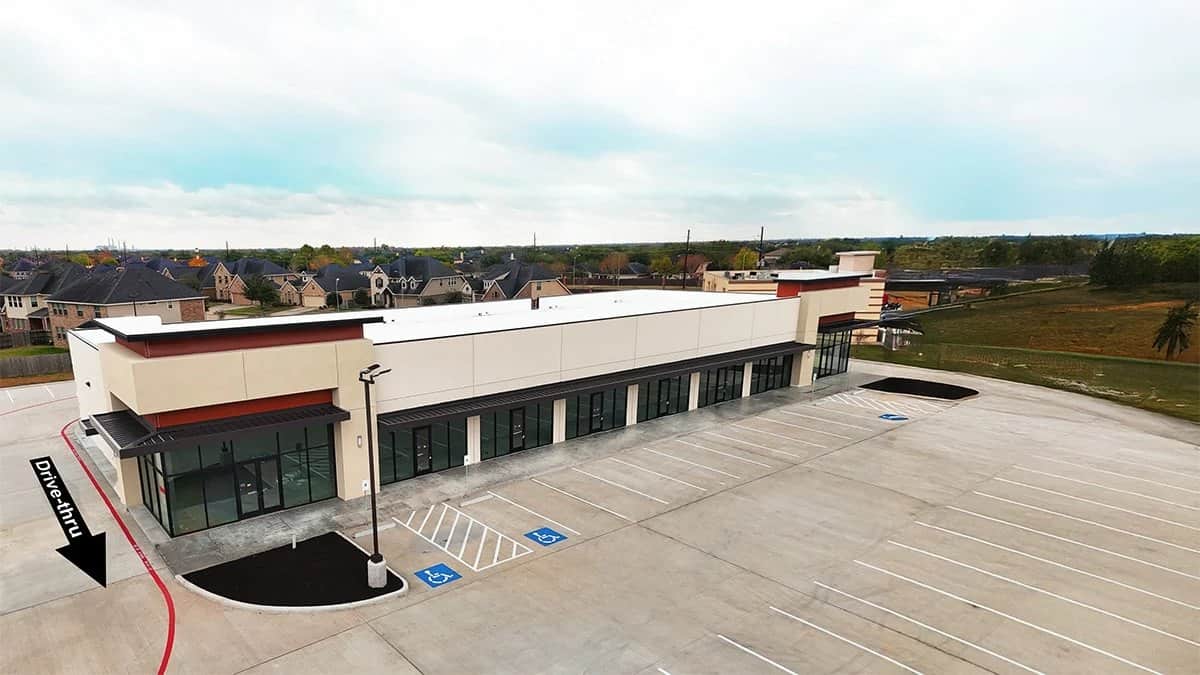
Wilmington's retail market has grown dramatically over the past two decades, tracking the population surge along the Cape Fear coast. The Mayfaire Town Center and the surrounding power retail on Military Cutoff Road anchor the northern retail cluster, while the strip centers along South College Road and Market Street serve established neighborhoods, and the Oleander Drive corridor threads through mid-town commercial activity. Retail rooftops across this geography contend with a coastal Carolina climate that delivers significant humidity year-round, Atlantic hurricane exposure, and a storm track that has brought direct hits from major hurricanes more frequently than any other mid-Atlantic coastal city in recent memory.
Hurricane Florence's impact on Wilmington in 2018 provided a detailed real-world test of commercial roofing performance in the Cape Fear region. Retail properties along Military Cutoff Road, Oleander Drive, and South College Road sustained a spectrum of damage ranging from minor membrane uplifts at parapet edges to catastrophic wind-driven rain infiltration through poorly detailed penetrations on buildings that appeared structurally intact. The contractors who had engineered their projects to North Carolina's coastal wind design speeds fared better than those who had applied inland standards to coastal properties. We design every Wilmington Retail Roofing project to the 130-mph or higher wind design speeds applicable to New Hanover County's coastal location.
TPO mechanically attached and fully adhered systems are the dominant specification for Wilmington's retail market, with mechanically attached systems more common on large open-field retail roofs like the warehouse clubs and home improvement stores near Independence Boulevard, where the fastener density required by coastal uplift calculations makes fully adhered systems cost-effective only on smaller footprints. All fastening patterns are engineered to current ASCE 7 provisions for Wilmington's coastal exposure category and the specific building geometry, perimeter and corner zones on coastal retail roofs require fastening densities that can be three to four times the field zone spacing.
Salt air corrosion in Wilmington affects every exposed metal component on retail rooftops within several miles of the Atlantic and the Cape Fear River. Standard galvanized hardware that performs acceptably in inland markets degrades in a few years at the coast. We specify marine-grade stainless steel or aluminum fasteners, hot-dipped galvanized drain bodies rated for marine exposure, and coated steel HVAC curb caps for all Wilmington retail projects. HVAC equipment frames not provided by the tenant's equipment supplier also receive zinc-rich primer and topcoat treatment before installation to extend their service life in the salt-laden air that prevails year-round in New Hanover County.
The Mayfaire Town Center and the retail corridors around Independence Mall set the baseline expectation for institutional-grade Retail Roofing in Wilmington. National grocery anchors, pharmacy chains, and the major casual dining and fast-casual restaurant operators concentrated in the Military Cutoff corridor maintain facilities standards that specify membrane type, thickness, warranty coverage, and installer certification. Meeting those standards requires current manufacturer certification, which we maintain with all major single-ply manufacturers whose products appear in national tenant specification packages. Tenant-facing documentation packages are prepared at project closeout, not assembled reactively when a tenant's facilities team requests records months later.
Drainage design for Wilmington retail roofs must account for the rainfall volumes generated by tropical systems, which can deposit 10 to 20 inches of rain over 24 to 48 hours during a slow-moving hurricane or tropical storm. Hurricane Florence's multi-day stall over the Cape Fear region produced 35 inches of rainfall at some New Hanover County locations. While roof drainage systems cannot be sized to handle a 500-year storm event, the combination of properly sized primary drains, clear emergency scuppers, and regular maintenance to ensure debris cannot block drain entrances provides the best available protection against the ponding and structural overloading risk that prolonged extreme rainfall events create.
Humidity management is an understated roofing challenge in Wilmington's subtropical coastal environment. The ambient relative humidity rarely drops below 50 percent year-round, and summertime afternoon values routinely exceed 90 percent. Roof assemblies on conditioned retail buildings create a vapor pressure differential that drives moisture into the assembly from the exterior during summer cooling conditions, the reverse of the winter vapor drive pattern seen in colder climates. Vapor retarder placement and insulation assembly design for Wilmington retail roofs requires analysis of the specific project's HVAC and occupancy conditions, not a generic specification borrowed from inland or northern markets.
Retail disruption management in Wilmington reflects the competitive nature of the local market. The Mayfaire area in particular has a dense concentration of retail, food service, and service tenants whose business models depend on consistent customer access and a well-maintained physical environment. Roofing construction debris in parking areas, construction equipment blocking storefronts, or dust infiltrating food service spaces generates tenant complaints and, in the worst cases, lease disputes. We deploy construction staging plans that keep parking access and pedestrian circulation functional throughout the project, use vacuum-equipped tear-off equipment to minimize loose debris, and conduct end-of-shift parking lot sweeps before tenants arrive for the next morning's opening.
Wilmington's growing healthcare retail presence, urgent care centers, dental practices, optical retailers, and pharmacy chains with clinical services areas embedded in strip centers along South College Road and Randall Parkway, creates a subset of Retail Roofing projects where contamination control goes beyond standard construction dust. Medical and dental offices require notification procedures and work window restrictions that align with HIPAA-regulated operations, and any mechanical work that temporarily disrupts interior environmental conditions requires coordination with the clinical staff. We treat healthcare retail tenants as a distinct project management category with escalated communication protocols rather than applying generic commercial construction procedures.
- How does Wilmington's hurricane history affect commercial roofing specifications?
- New Hanover County's history of direct hurricane landfalls, including Florence in 2018 and multiple prior events, has shaped local building code enforcement and contractor awareness of wind design requirements more concretely than in many coastal markets where the risk is theoretical. We design all Wilmington Retail Roofing projects to the ASCE 7 wind design speeds applicable to the specific building's location and exposure category, engineer perimeter and corner fastening zones separately from field zones, and specify metal edge details rated for the design wind speed. These are baseline requirements, not upgrades.
- What roofing materials hold up best in Wilmington's salt air environment?
- The membrane itself, whether TPO or PVC, is not significantly affected by salt air, but every metal component in the roofing assembly is at risk. Stainless steel fasteners, aluminum drain bodies, marine-grade-coated HVAC curb hardware, and protected pipe supports are the standard specifications for Wilmington retail projects within the coastal salt exposure zone. The incremental cost of corrosion-resistant hardware is recovered many times over when the hardware is still functioning properly 15 years into the membrane's service life rather than requiring replacement at year 5.
- How are Wilmington retail roofs prepared for hurricane season?
- Pre-storm preparation for Wilmington retail roofs includes verifying that all drains are clear and scuppers are unobstructed, inspecting perimeter and edge metal for any sections that have been loosened or displaced, confirming HVAC curb attachments are secure, and checking that any recently made penetrations or repairs are fully cured and sealed. We offer a pre-season preparation inspection service each spring that addresses all of these items and provides a written report confirming readiness. Emergency response services are available after storm events for temporary tarping and damage documentation.
- What is the typical warranty available on a commercial retail roof in Wilmington?
- Manufacturer-backed system warranties of 15 to 20 years are standard on new TPO and PVC installations completed by certified contractors using approved assemblies. These warranties cover both material defects and workmanship in most cases, and they require periodic manufacturer inspections to remain valid. For coastal North Carolina, warranty language should be reviewed to confirm coverage of wind-driven rain events, as some manufacturer warranties include exclusions or sub-limits for storm damage that differ from standard coverage. We provide warranty documents at closeout and advise on the inspection schedule required to maintain warranty validity.
- Do Wilmington retail property owners need a licensed contractor for roof replacement?
- Yes. North Carolina requires commercial roofing contractors to hold a state contractor's license issued by the NC Licensing Board for General Contractors, with the roofing classification covering installations on commercial properties. New Hanover County additionally requires building permits for commercial roof replacements, and the permit process verifies contractor licensing. We are licensed in North Carolina and maintain the required insurance and bond levels for commercial projects in Wilmington. Working with unlicensed contractors on commercial retail properties voids manufacturer warranties and creates liability exposure for property owners.