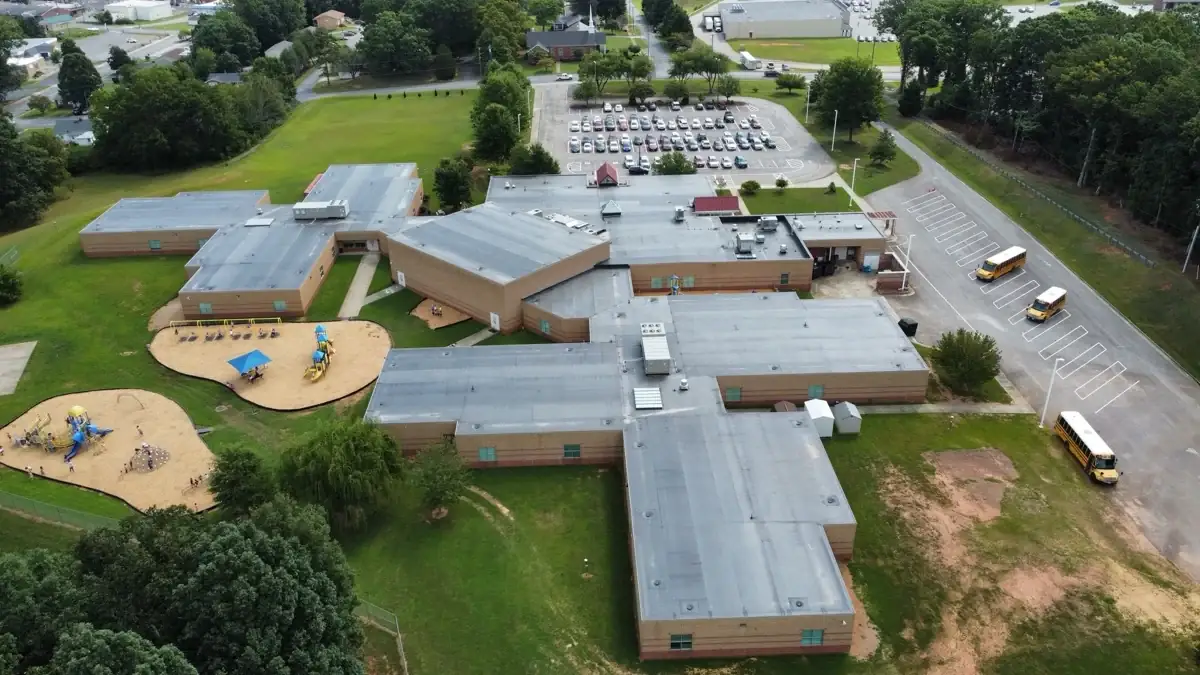
New Hanover County Schools, the school district serving Wilmington and all of New Hanover County with over 27,000 students across approximately 40 campuses, faces roofing challenges that are inseparable from the county's coastal position and its well-documented hurricane history. The district's building portfolio spans from 1950s brick elementary schools in Wilmington's historic neighborhoods to modern schools constructed after Hurricane Floyd's devastation in 1999 prompted a major rebuilding and hardening program. Reroofing these buildings requires a contractor who understands both coastal wind engineering and the public school procurement environment in North Carolina.
North Carolina's construction history with tropical storms is seared into New Hanover County Schools' institutional memory. Hurricane Floyd in 1999 and Hurricane Florence in 2018 both caused significant damage to district buildings, requiring emergency repairs and in some cases major reconstruction. The district's post-Florence recovery involved navigating FEMA Public Assistance funding, State Capital and Infrastructure Fund grants, and the North Carolina Department of Public Instruction's Facilities Finance Section,a multi-agency process that exposed several weaknesses in pre-storm documentation that affected the district's ability to substantiate damage extents and reconstruction costs. We help current NHCS facilities staff develop documentation practices that support a more efficient PA claim process if a future major storm requires it.
Hurricane preparedness for NHCS roofing begins before storm season each year with a systematic inspection of the highest-risk roof conditions on the oldest campuses. Edge metal attachment, parapet cap conditions, equipment curb anchorage, and drain overflow provisions are the inspection priorities,these are the locations where wind uplift and storm water infiltration failures begin. We complete pre-season condition sweeps for NHCS by May 1 and deliver a written summary of urgent conditions to district facilities staff before the June 1 hurricane season start, allowing emergency repairs to be completed on the highest-priority items before the first storm threat of the season.
North Carolina prevailing wage requirements for public school construction are governed by the North Carolina Wage and Hour Act and, for federally funded projects, Davis-Bacon Act requirements. NHCS projects using federal E-Rate, Title I, or CDBG funding carry Davis-Bacon obligations with wage determinations published by the U.S. Department of Labor for the Wilmington, NC area. We maintain current Davis-Bacon compliance documentation and certified payroll reporting capability for federally funded NHCS projects, and we advise district procurement staff on applicable wage requirements before bidding to ensure that bid documents include correct wage determinations from the outset.
Summer scheduling for NHCS school projects must account for the district's summer learning programs, the Wilmington-area community recreation programs that use school facilities, and the construction weather risk that Cape Fear summers impose. Afternoon thunderstorms are frequent from June through August, humidity is extreme, and the active hurricane season means that any rooftop exposure risk must be managed with daily weather monitoring and rapid-deploy temporary waterproofing capability. We build these weather management protocols into every NHCS summer project plan and staff projects at levels that allow accelerated completion to reduce total days of weather exposure risk.
Coastal material specifications for NHCS projects follow the same corrosion-resistance requirements that govern all commercial construction in Wilmington's salt-air environment. All metal roofing accessories,edge metal, drain bodies, vent curbs, and equipment anchor plates,must be aluminum, stainless steel, or copper at every NHCS campus. We extend this specification to fasteners, clips, and hardware throughout the roofing assembly because a single corroded fastener that fails in a storm can initiate a progressive edge metal or membrane uplift failure. Corrosion-resistant specification adds modest cost at installation time and prevents the much larger costs of storm damage repairs and emergency response.
Energy performance for NHCS buildings is a budget priority because the district's operating costs in Wilmington's cooling-dominated coastal climate are substantially driven by air conditioning loads in buildings with large roof areas and historically modest insulation. Many of the district's mid-century elementary school buildings have roof assemblies with effective insulation values below R-10, including only the original built-up roofing felt layers. Upgrading to current North Carolina Energy Conservation Code standards,requiring R-25 minimum continuous insulation for new roofing in Climate Zone 3,at the time of reroofing significantly reduces cooling loads and delivers operating cost savings that partially offset the reroofing capital investment.
Stormwater management is a locally significant environmental compliance issue in coastal New Hanover County, where imperviousness and stormwater discharge from school campuses are subject to regulation under the Wilmington-New Hanover County Stormwater Management Program. Reroofing projects that increase impervious surface or modify drainage patterns may trigger stormwater management review. We assess stormwater compliance implications for each NHCS project during the pre-design phase and include required stormwater management measures in project scope when changes to the drainage system are involved.
Post-storm recovery planning for NHCS requires that the district have current documentation of every campus roof's pre-storm condition. We maintain condition records for NHCS campuses in our project management system and provide updated digital condition documentation at each annual inspection visit. When a storm occurs, this baseline documentation is immediately available to support FEMA PA applications, insurance claims, and North Carolina DPI emergency facilities reporting,eliminating the scramble to reconstruct pre-storm condition evidence that complicated previous NHCS storm recovery efforts.
- How does NHCS qualify for FEMA Public Assistance funding after a hurricane?
- FEMA PA funding requires a presidential disaster declaration, documented pre-storm facility conditions, photographs and cost evidence of storm damage, and completed project worksheets submitted through the state emergency management PA process. Pre-storm condition documentation maintained through annual inspections significantly strengthens PA applications by establishing a clear baseline from which damage can be measured. We provide this documentation as part of our ongoing service program for NHCS.
- What wind speed governs roofing design for New Hanover County school buildings?
- ASCE 7 specifies design wind speeds of 130 to 140 mph for New Hanover County's coastal location. We specify roofing systems meeting FM 1-90 minimum for interior field areas and enhanced attachment meeting elevated requirements at perimeter and corner zones where wind uplift forces are significantly greater than field area forces.
- How do you manage hurricane-season weather risk during summer school construction?
- We plan daily work sequences to complete all roof exposure and tearoff before afternoon storm risk increases, maintain temporary waterproofing capability on-site at all times, and monitor Cape Fear-area tropical weather development continuously during summer projects. We have pre-established storm preparation protocols that allow rapid securing of all rooftop work areas when a storm threat requires suspending construction.
- What are the North Carolina Energy Conservation Code insulation requirements for school reroofing?
- North Carolina currently follows the 2021 IECC which requires R-25 continuous insulation for Climate Zone 3 commercial roof assemblies. Reroofing projects may use alternative compliance pathways, but we recommend achieving at minimum R-20 continuous insulation on all NHCS reroofing projects to meaningfully improve energy performance and position the district for compliance with future code cycles.
- Can you develop a campus-by-campus reroofing capital plan for NHCS?
- Yes. We conduct portfolio-level condition assessments that assign condition ratings, estimated remaining useful life, and priority classifications to each campus roof section. The resulting capital plan, formatted for North Carolina DPI facilities reporting and district budget presentations, gives facilities staff a prioritized, costed roadmap for managing the district's roof asset portfolio over a five to ten year horizon.