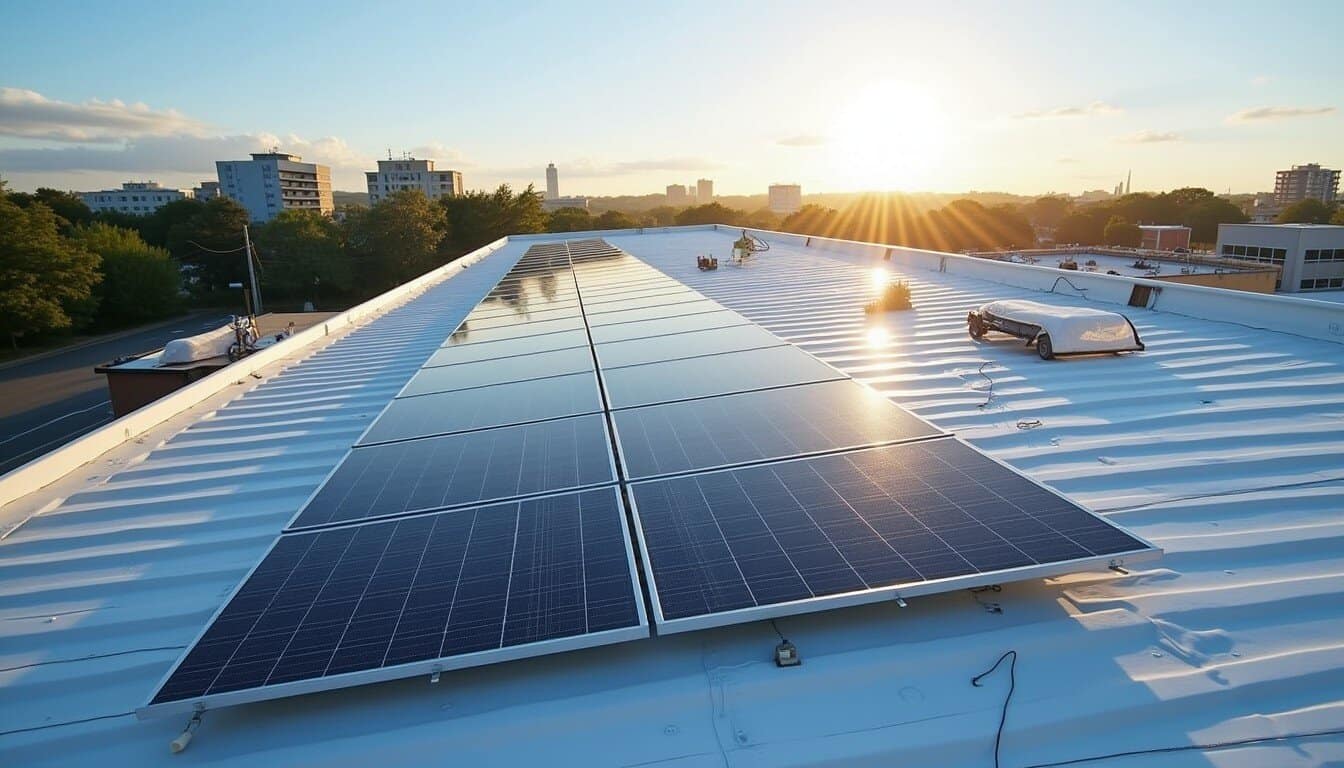
Wilmington's commercial corridors include the US-74 and US-17 commercial and industrial belts, the South Front Street and Cargo District redevelopment zones, the Wilmington International Airport area employment hub, and the Brunswick County suburban growth areas. Commercial solar adoption in this market is driven by federal ITC incentives, state utility programs, and the direct operating cost benefits of on-site generation, but a solar investment built on a membrane that has five or fewer years of service life remaining will require costly array removal and reinstallation during the next roof replacement cycle.
Solar Roof Integration for commercial buildings in Wilmington, NC is first a roofing project and second a solar project. The sequence matters: a photovoltaic system installed on a roof membrane that has five to eight years of remaining service life will require costly solar array removal and reinstallation when the membrane needs replacement, adding $30,000 to $80,000 to the cost of the reroofing project depending on system size. Before any solar installation is contracted, we assess the existing roof membrane condition, provide a remaining service life estimate, and recommend whether to reroof before solar installation or plan the solar scope alongside a simultaneous reroof.
Rooftop solar ballast loads and attachment point penetrations are the two primary roofing concerns on a commercial solar project. Ballasted racking systems, the most common approach on low-slope commercial roofs, distribute weight across a broad membrane area using pavers or concrete blocks rather than penetrating the membrane. The total ballast load per square foot must be confirmed against the building's structural load capacity, particularly on older buildings with lower original design loads. Penetration-anchored systems create flashing requirements at each racking foot, these penetrations require the same attention to flashing detail as any other roof penetration and must be covered by the membrane warranty.
Conduit runs from rooftop solar arrays to the building's electrical service typically penetrate the roof membrane at multiple points. These runs need to be planned with the roofing contractor before the solar electrician installs conduit, conduit that is fastened directly to the membrane without proper standoffs creates abrasion damage over time, and conduit penetrations that are flashed with generic boot flashings rather than proper through-roof conduit details become chronic leak points. We coordinate with the solar EPC during pre-construction on conduit routing and penetration flashing design to prevent these failures.
Solar Roof Integration in Wilmington benefits from federal Investment Tax Credit (ITC) incentives, available NC state incentive programs, and utility net metering rates that vary by service territory. We do not sell solar systems, but we are well-positioned to help commercial property owners understand the roofing conditions that affect the economics of a solar investment, and to ensure the roof substrate is properly prepared before a solar contractor is engaged. A solar system installed on the wrong roof by the right solar contractor is still a costly mistake.
Solar Roof Integration Questions
Should we reroof before installing solar, or can we install solar on the existing roof?
The answer depends on the existing membrane's remaining service life. If the roof has 15+ years of documented service life remaining, solar installation on the existing membrane is appropriate. If the roof has 7 years or less of expected remaining life, reroofing before solar installation is almost always the better economic decision, the cost of removing and reinstalling a solar array during a future reroof exceeds the cost of reroofing now and installing solar immediately after. We assess the membrane condition and provide a service life estimate as part of our pre-solar consultation.
Do solar panel attachment points require roof penetrations?
Ballasted racking systems for low-slope commercial roofs use weighted blocks to hold the array in position without penetrating the membrane, this is the most common approach for flat or near-flat roofs in Wilmington. Penetration-anchored systems are used on sloped roofs and on flat roofs where structural load limits prevent adequate ballast. When penetrations are required, each attachment point is flashed individually to the manufacturer's specification and covered under the membrane warranty.
How does solar installation affect the roofing warranty?
Most major single-ply membrane manufacturers accommodate rooftop solar installation on their warranted systems if the system design and installation follows their requirements, specifically: approved ballast pads, approved walkway protection, approved penetration details for anchored systems, and pre-installation review by the manufacturer's warranty representative. We coordinate the manufacturer warranty review as part of any solar-plus-roofing project to ensure the solar installation does not void the membrane warranty.
What roofing membrane system works best under a solar array?
White TPO 60-mil or PVC 60-mil mechanically attached is the most common specification for commercial solar roof systems in Wilmington. White reflective membranes improve solar panel efficiency by reducing the temperature of the surface beneath the array, and the mechanically attached system provides a stable, uniform substrate for ballasted racking. Fully adhered systems are appropriate where structural loads limit ballast weight.
Do you coordinate with the solar contractor on the installation sequence?
Yes. Roofing and solar installation must be sequenced correctly, the membrane is installed and inspected before any solar racking is placed, and conduit penetrations are flashed by the roofing contractor (not the solar electrician) before conduit is pulled. We provide a pre-construction coordination meeting with the solar EPC to document the sequence, the conduit routing plan, the penetration detail specifications, and the final inspection requirements for both the roofing and solar warranty registration.