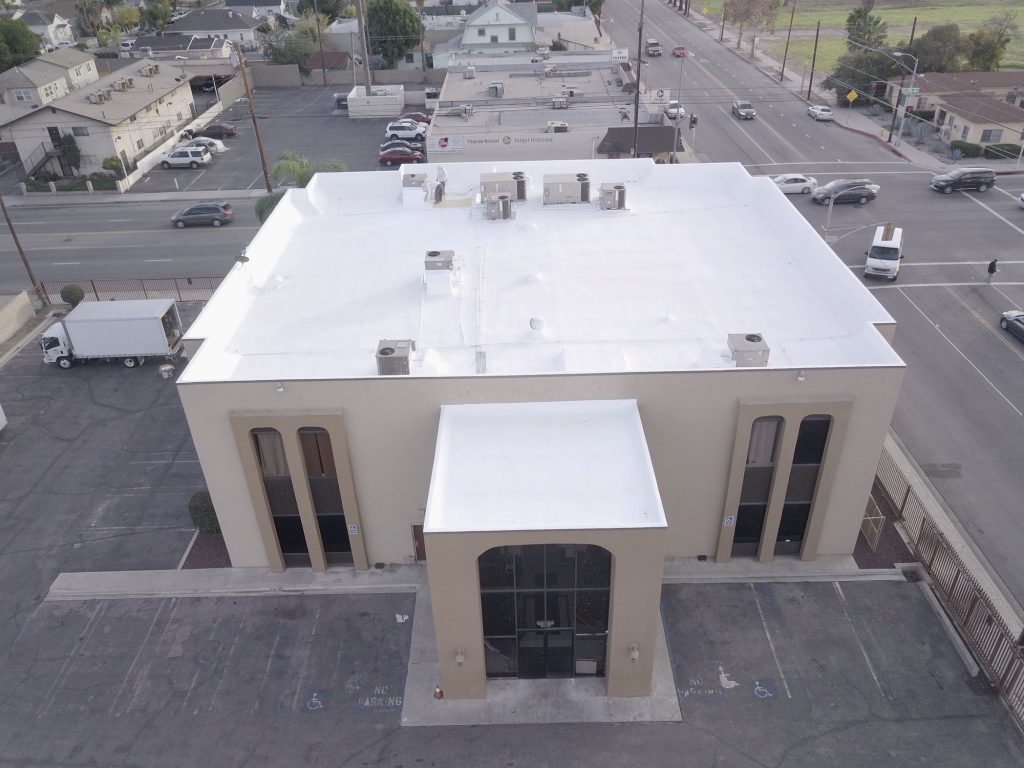
Spray polyurethane foam roofing has earned a specific niche in Wilmington's commercial and industrial market that is defined less by building type than by roof geometry. SPF excels on roofs where the complexity of the surface, multiple levels, irregular shapes, equipment platforms, expansion joints, and transitions between roof sections, makes conventional sheet membrane installation difficult to detail correctly. Industrial and warehouse buildings in Northchase and International Logistics Park sometimes have roof geometries accumulated over years of building additions and equipment installations that create a patchwork of levels and transitions that no sheet membrane can flash without dozens of complex detail conditions. SPF, applied as a liquid that conforms to any substrate geometry and cures into a continuous, seamless monolithic surface, eliminates those detail conditions entirely. There are no seams, no laps, and no complex flashing transitions, just a continuous foam surface that rises with the substrate geometry and is coated for UV protection.
The coating selection on SPF roofing systems is where the Wilmington coastal environment most directly affects specification decisions. Uncoated SPF degrades rapidly under UV exposure, the foam's cellular structure breaks down at the surface, creating a crumbly, eroded condition that progresses inward if not protected. In Wilmington's intense coastal UV environment, the right coating system is critical, and the coating needs to perform for a decade or more between recoat cycles while providing the UV protection that keeps the foam below it intact. Silicone topcoats are the preferred choice for Wilmington SPF applications. Silicone is inherently UV-resistant, does not degrade under the intense coastal UV that accelerates degradation of acrylic topcoats, and provides the ponding water resistance that matters after tropical rainfall events. An acrylic topcoat on SPF in Wilmington's climate will typically require recoating in 5 to 7 years, a silicone topcoat applied at the correct mil thickness can deliver 10 to 15 years of UV protection before recoating is needed.
SPF's insulation value is among the highest of any roofing system on a per-inch-of-thickness basis. Closed-cell SPF achieves R-values of approximately R-6 per inch, meaning that a two-inch SPF application provides R-12, equivalent to three inches of polyisocyanurate board insulation. For industrial buildings in Wilmington's coastal climate that need to improve thermal performance without adding significant thickness to the roof assembly, SPF can deliver substantial R-value improvement in a thin profile. The thermal performance argument is particularly relevant in Wilmington's hot, humid summers, where reducing heat gain through industrial roof assemblies reduces cooling loads and, on climate-controlled warehouse and manufacturing spaces, can produce significant energy cost savings against Duke Energy Progress commercial rate structures.
The seamless nature of an SPF system directly addresses one of the primary vulnerability patterns in Wilmington's storm environment. In a tropical event with sustained wind-driven rain, water infiltration occurs at seams, laps, and flashing transitions, the discrete connection points in any sheet membrane system. SPF has none of these. The foam bonds to the substrate and to itself at the boundaries of each pass, creating a continuous surface that has no discrete seam for wind-driven water to infiltrate. The vulnerability point in an SPF system is the coating, if the silicone or acrylic topcoat develops cuts, punctures, or surface degradation that exposes foam to direct water contact, the foam begins to absorb moisture at that point. This is why coating condition maintenance is the primary ongoing responsibility for an SPF roof owner, and why we recommend annual inspection of the coating surface on SPF roofs in Wilmington's coastal UV environment.
SPF application on coastal Wilmington industrial buildings requires attention to substrate preparation and application conditions. SPF adhesion depends on a clean, dry substrate, moisture on the substrate surface at the time of application produces a bond failure. Wilmington's humidity complicates this: dew point management is important when scheduling SPF application, and morning application in humid coastal conditions must wait until the substrate temperature has risen above the dew point. We monitor weather conditions carefully in the days before and during SPF application and will not proceed when substrate moisture conditions are outside the manufacturer's application parameters. A day's delay to ensure correct application conditions is worth far more than the schedule disruption.
SPF roofing on coastal buildings near the Atlantic, the Intracoastal Waterway, or the Cape Fear River requires specific attention to wind conditions during application. SPF is a spray-applied material and overspray in wind conditions can affect neighboring buildings, vehicles, and sensitive equipment. We establish perimeter exclusion zones and monitor wind speed and direction during application to prevent overspray incidents. Application is suspended when wind conditions exceed safe application parameters. This is standard practice on any SPF project, but it is particularly important in Wilmington's coastal environment where wind is a consistent variable and neighboring buildings may be in close proximity on commercial corridors.
Roof penetrations and existing equipment on SPF roofs are handled differently than on sheet membrane systems. Rather than installing a separate pipe boot or curb flashing detail, SPF is sprayed directly against the penetration and allowed to cure to it, forming a continuous seal that does not rely on mechanical fasteners or adhesive lap joints. Additional foam is built up around curb bases to create the required height transition. The result is a penetration seal that is as continuous as the field membrane, there is no discrete transition joint for water to infiltrate. On buildings with many penetrations, industrial facilities with conduit, pipe, and equipment curb density, this continuous penetration sealing is a significant advantage over sheet membrane systems that require individual flashing details at every penetration.
Recoating is the primary maintenance requirement for an SPF roof in Wilmington, and it needs to be executed on the right timeline to protect the foam below the coating from UV degradation. We recommend annual inspection of the coating surface on all SPF roofs we install in this market, looking for granule loss on granule-surfaced coatings, surface chalking that indicates UV weathering of acrylic topcoats, and any cuts or punctures in the coating surface. When the coating shows signs of approaching the end of its protective life, recoating restores UV protection and extends the system's service life at a fraction of the cost of a full replacement. The recoat timeline depends on the coating type: silicone topcoats typically last 10 to 15 years in Wilmington's coastal UV conditions, acrylic topcoats typically 5 to 8 years. We track recoat timing for SPF clients in our maintenance program and schedule recoat projects proactively rather than waiting for visible foam degradation to appear.
For commercial building owners evaluating SPF for the first time, the questions typically center on long-term performance and the commitment to ongoing maintenance. SPF is not a set-and-forget system, it requires coating maintenance on a defined schedule to maintain its UV protection and waterproofing integrity. Owners who commit to that maintenance schedule get a durable, energy-efficient, seamless roofing system that performs well in Wilmington's climate. Owners who do not maintain the coating will see progressive foam degradation that eventually requires foam repair or removal before the system can be restored. We are direct about this during the project evaluation phase because the maintenance commitment is a real factor in whether SPF is the right choice for a particular building owner.
Questions Owners Ask
How does SPF roofing hold up in a Wilmington hurricane?
A fully cured, properly coated SPF system with correct substrate adhesion has good wind resistance because the foam is bonded continuously to the deck, there are no loose edges or seam lines for wind uplift to attack. The coating surface resists wind-driven rain infiltration because there are no discrete seam or lap joints. The most vulnerable condition for an SPF roof in a hurricane is surface damage from flying debris, which can cut or puncture the topcoat and expose foam to direct water contact. Post-storm inspection of the coating surface and prompt repair of any punctures is the appropriate post-hurricane response for SPF roof owners.
How long does an SPF roof last in Wilmington's coastal climate?
The foam substrate itself can last 30 to 50 years when properly protected by a maintained topcoat. The coating, not the foam, is the finite-life component. Silicone topcoats in Wilmington's coastal UV environment typically deliver 10 to 15 years before recoating is needed. Acrylic topcoats last 5 to 8 years. Each recoat cycle renews the system's UV protection and extends its total service life. An SPF system that is recoated on schedule effectively has an indefinite service life, the foam does not need to be removed and replaced, only the protective topcoat needs periodic renewal.
Can SPF be applied over my existing roof without a tear-off?
Yes, with the same qualification that applies to any recover: the existing substrate must be dry. We conduct infrared scanning and core sampling before any SPF application to verify insulation moisture condition. SPF applied over wet insulation traps the moisture and does not bond correctly to the wet substrate. If the existing system is dry and in adequate condition, SPF application over it is a viable recover option. If significant wet insulation is present, it must be removed before SPF can be applied.
What maintenance does an SPF roof require annually?
Annual visual inspection of the topcoat surface is the primary maintenance requirement. We look for cuts, punctures, surface chalking, granule loss, and any areas where the topcoat has thinned or been damaged. Minor cuts and punctures are repaired with compatible coating materials at the time of inspection. When the topcoat shows signs of overall UV weathering that indicates the end of its protective life, a full recoat is scheduled. Drains are cleared and penetrations are inspected as part of the annual visit. The annual inspection cost is modest, and the consequence of deferring it is potential foam degradation that becomes much more expensive to correct than a timely recoat would have been.
Is SPF a good choice for a flat warehouse roof in Northchase or Pender Commerce Park?
It can be, depending on the specific building. SPF works best on roofs with complex geometry, multiple levels, many penetrations, irregular shapes, where its seamless application eliminates difficult detail conditions. On a large, simple flat warehouse roof with minimal penetrations and good drainage, a standard TPO or EPDM system may be more cost-effective and simpler to maintain. The geometry complexity argument is the primary case for SPF on industrial roofs in those corridors. We assess each building individually and recommend SPF when its characteristics are a genuine fit rather than as a default option.