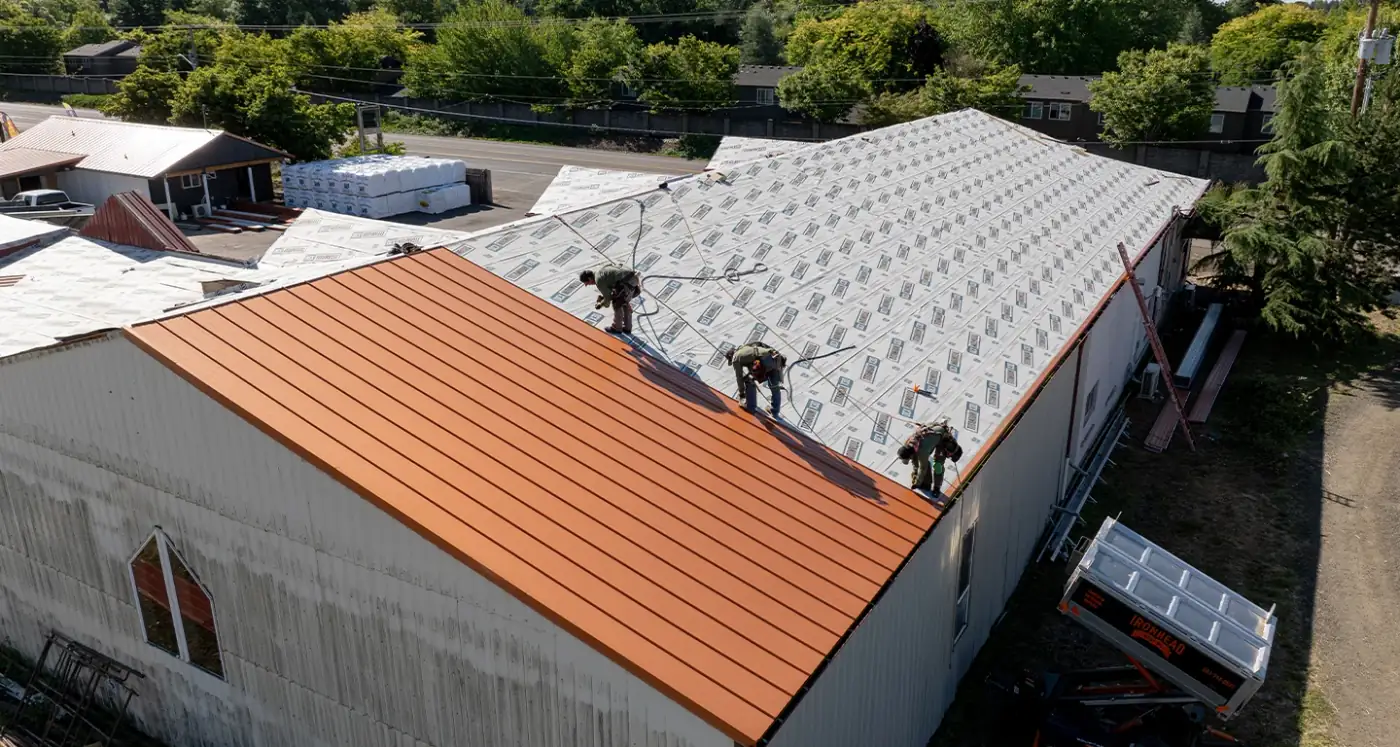
Standing Seam Metal Roofing is the right system for coastal Wilmington's hospitality and mixed-use buildings in a way that no other roofing system quite matches. The properties at Wrightsville Beach, Carolina Beach, and Kure Beach, hotels, condominium buildings, restaurants, and commercial buildings within sight of the Atlantic, face the most aggressive combination of salt air, UV exposure, wind loading, and rainfall of any commercial roofing environment in North Carolina. Standing seam metal, with its concealed fasteners, factory-applied Kynar coating, and continuous seam system that provides both watertightness and exceptional wind uplift resistance, addresses each of those conditions more comprehensively than any membrane system. It is also, honestly, the aesthetic choice that matches the architectural expectations of coastal Carolina commercial buildings, a Kynar-coated standing seam roof on a Wrightsville Beach hotel looks right in a way that a white TPO membrane does not.
The concealed-fastener distinction between standing seam and exposed-fastener R-panel is the defining performance difference in coastal Wilmington's salt-air environment. R-panel's through-fasteners, screws penetrating the panel face with rubber washers at each fastener, are the system's primary corrosion vulnerability. In coastal conditions within two miles of tidal water, those fastener washers degrade and the fastener shanks corrode within 8 to 12 years, creating water infiltration points and reducing the panel's wind attachment strength. Standing seam eliminates this vulnerability entirely. The panels are attached to the structure through concealed clips that are hidden beneath the seam profile, no fastener penetrates the panel face, no fastener is exposed to salt air, and no washer degrades in coastal UV. A correctly installed standing seam system in coastal conditions has a service life measured in decades, not years, between significant maintenance interventions.
Hurricane wind-load performance of standing seam metal is substantially better than exposed-fastener systems. The continuous seam profile distributes wind uplift across the full seam rather than concentrating it at individual fastener points, and the clip attachment system allows the panel to expand and contract with temperature changes without creating fastener fatigue. Uplift testing of standing seam systems at required wind speeds for Wilmington's coastal wind zone, ASCE 7 exposure categories that reflect the Cape Fear coast's hurricane exposure, confirms the performance of correctly specified systems. We specify standing seam systems with clip attachment patterns and seam profiles that meet the uplift requirements for the building's specific exposure category, not minimum code values from inland tables that do not reflect Wilmington's actual coastal wind loading.
Cor-Ten weathering steel versus Kynar-coated steel or aluminum is a material selection question that comes up on coastal Wilmington commercial projects, particularly on boutique hospitality buildings and architectural commercial construction where the weathered steel aesthetic is desirable. The answer in coastal salt-air environments is nuanced. Cor-Ten develops its protective oxide patina through a wetting and drying cycle that halts further corrosion once the patina is established, but in a coastal environment with essentially continuous salt-air moisture exposure, that drying cycle may not occur consistently enough for the patina to stabilize properly. The result can be ongoing corrosion rather than the stable patina that Cor-Ten achieves in inland environments. We recommend discussing Cor-Ten applications in coastal Wilmington specifically with the steel supplier and reviewing the specific building location's exposure before specifying it, and for most coastal hospitality applications, Kynar-coated steel or aluminum with a color selection that achieves the desired aesthetic is the more predictable long-term performer.
Thermal movement management is a standing seam installation discipline that is more demanding in coastal Wilmington's climate than in milder markets. The wide annual temperature range, from winter lows in the low 30s to summer highs in the mid-90s, combined with the UV intensity at coastal latitudes creates significant panel temperature differentials across seasons. A 100-foot standing seam panel run in a dark color can experience temperature swings of 100°F between a clear January night and a direct-sun August afternoon. That temperature differential drives significant panel length change, steel expands and contracts at approximately 0.0000065 inches per inch per degree Fahrenheit, meaning a 100-foot run sees more than an inch of movement across that temperature range. Standing seam clip systems must accommodate this movement without restraining the panel, and eave and ridge details must allow for expansion without buckling or leaking. We design standing seam systems with correct clip type selection and panel run length limits to accommodate the thermal movement that Wilmington's climate requires.
Gutters on Standing Seam Metal Roofing in the Wilmington market need to be specified for the drainage volume that 60 inches of annual rainfall produces, and for the corrosion resistance that coastal salt air demands. Residential-grade K-style aluminum gutters attached to commercial standing seam roofs are undersized for the drainage area and corrode rapidly in coastal conditions. We specify commercial-grade box gutters in Kynar-coated steel or heavy-gauge aluminum with corrosion-resistant finishes, sized using drainage calculations for the roof area and Wilmington's design rainfall intensities. Gutter attachment to the fascia system must be compatible with the standing seam panel's thermal movement, a gutter system that is rigidly attached without allowing for panel movement will produce fascia distortion or gutter separation over time.
Standing seam metal on steep-slope sections of coastal hospitality buildings, hip and gable roofs on hotel towers, restaurant buildings with architectural roof forms, requires attention to valley and ridge flashing details that are exposed to both wind-driven rain and UV degradation. Valleys on steep-slope standing seam must be detailed with concealed valley flashing that directs water out of the valley without creating dams or overflow conditions during heavy coastal rainfall. We specify valley flashing materials compatible with the panel material, using dissimilar metals in a valley condition creates galvanic corrosion in the salt-air environment. Ridge caps are designed with adequate lapping and fastening to resist the uplift forces that hurricane winds generate at ridge lines, where wind pressure is concentrated.
The installed cost of standing seam metal is higher than TPO or R-panel for equivalent roof area. That cost premium is justified on coastal hospitality buildings by the combination of longer service life, lower maintenance cost over that life, better hurricane performance, and the aesthetic value of a standing seam appearance on a property where architectural quality is a competitive asset. For industrial and warehouse buildings where aesthetics are not a factor and the primary drivers are cost and performance, R-panel or single-ply membrane may be the right answer. Standing seam is the right specification when its performance characteristics and appearance justify the premium, we present that analysis honestly and recommend it for the applications where it genuinely fits.
Every standing seam installation we complete is inspected systematically before final acceptance, seam engagement at each clip, end dam condition at eaves and rakes, valley and ridge cap fastening and sealant, and penetration flashing at any rooftop equipment or conduit runs. Standing seam is a precision-installed system and installation quality determines whether the system delivers on its performance potential. We train our standing seam crews specifically on the techniques and quality standards that the system requires and do not delegate standing seam installation to crews without the specific experience the system demands.
Questions Owners Ask
How does standing seam metal hold up in a direct hurricane hit on the Wilmington coast?
A correctly specified and installed standing seam system with clip attachment patterns designed for the coastal wind zone performs significantly better in hurricane conditions than exposed-fastener R-panel or standard single-ply membrane with mechanical attachment. The continuous seam distributes uplift loads, the concealed clip eliminates fastener pullout failure, and the panel geometry sheds wind-driven rain effectively. Post-storm damage on standing seam roofs in well-documented hurricane events is typically limited to perimeter details and penetration flashings rather than field panel failure, which is exactly the performance profile you want.
What is the best metal panel coating for a building right on Wrightsville Beach?
Kynar 500 (PVDF) fluoropolymer coating is the standard specification for coastal applications, it has superior UV resistance, color retention, and salt-air corrosion resistance compared to standard polyester or silicone-modified polyester panel coatings. For buildings within 1,000 feet of tidal water, we specify Kynar-coated panels and recommend against standard painted finishes. Panel substrate selection matters too, Galvalume steel with Kynar coating is the most common and cost-effective choice; aluminum with Kynar is lighter and inherently more corrosion-resistant but at higher material cost. We discuss both options for beachfront applications.
Can standing seam metal be installed over my existing roof without a tear-off?
Yes, in some configurations. Standing seam can be installed over existing membrane roofing using a sub-framing system that creates the required slope and bearing points for the standing seam panels without requiring removal of the existing membrane. This approach is used when the existing membrane is in adequate condition and the additional structural load of the metal system can be supported by the existing structure. We assess the structural capacity and existing system condition before designing any over-existing installation, and we conduct infrared scanning to verify insulation moisture condition beneath the existing membrane.
How long should a standing seam roof last on a coastal Carolina commercial building?
A Kynar-coated Galvalume standing seam system installed correctly on a coastal Carolina commercial building should deliver 40 to 60 years of service life with routine maintenance. The primary maintenance items are gutter cleaning and inspection, periodic fastener check at perimeter and penetration details, and sealant replacement at any through-fastener penetration points. The standing seam field panels themselves, with no exposed fasteners and a durable Kynar coating, require minimal intervention. That service life, two to three times longer than a typical single-ply membrane system, is part of the total lifecycle cost argument for standing seam on a building where the premium is justified.
We have a beachfront hotel at Carolina Beach. Is standing seam the right choice for replacement?
For a coastal hospitality property at Carolina Beach, standing seam metal is almost certainly the right long-term answer. The combination of salt-air performance, hurricane wind resistance, and the service life that eliminates multiple replacement cycles over the building's life makes the premium cost justifiable. The aesthetic also aligns with the coastal commercial architecture context. The specific details, panel profile, color, substrate material, attachment pattern, need to be designed for your specific building geometry and exposure, and we would want to assess the existing structure and roof configuration before finalizing a recommendation. But the system choice is the right one for the application.