Wilmington's commercial corridors include the US-74 and US-17 commercial and industrial belts, the South Front Street and Cargo District redevelopment zones, the Wilmington International Airport area employment hub, and the Brunswick County suburban growth areas. Storm damage documentation and insurance claim roofing in this market requires a contractor who can produce GPS-tagged hail impact maps, wind damage assessments, and supplemental claim documentation in the format that commercial property adjusters use, not just a repair estimate, but the evidence package that documents the claim at full scope.
Storm Damage Roof Repair in Wilmington is not a niche service category that gets called on twice a decade. It is an ongoing operational reality that shapes how we staff, how we plan, and how we communicate with commercial property owners throughout New Hanover, Brunswick, and Pender counties. The Atlantic hurricane season runs June 1 through November 30, six months of the year during which named storms, tropical storms, and significant convective systems can reach the Cape Fear coast with little warning and cause roof damage across hundreds of commercial properties simultaneously. Florence in 2018, Matthew in 2016, and Dorian in 2019 were the most severe events of the past decade, but between them came a steady sequence of tropical storms, near-misses with offshore intensification, and severe thunderstorm events that produced wind, hail, and flooding damage across the Wilmington commercial market every single year. Waiting until the next major event to have a storm damage response plan is waiting too long.
The storm damage calendar in Wilmington has two distinct seasons within the broader hurricane season. The early season, June through August, is dominated by convective storm activity: afternoon thunderstorms that develop over the heated land surface and can produce 60 to 80 mph wind gusts, hail, and intense short-duration rainfall. These events cause localized but significant commercial roof damage, torn membrane at perimeter conditions, failed pipe boots, damaged R-panel metal sections, blocked drains that overflow during the intense rainfall. Late season, September through November, is when the most dangerous organized tropical systems typically arrive, with the sustained winds and multi-day rainfall that produce the large-scale, widespread damage that Florence and Matthew exemplified. Both seasons produce repair demand, but the late-season events are when the entire Wilmington commercial roofing market is responding simultaneously to a regional damage event.
Rapid assessment after a storm event is the first service need. Commercial property owners dealing with potential roof damage need to know quickly: Is there active water intrusion? How extensive is the damage? What temporary protection is needed immediately? What is the permanent repair scope and cost? We respond to storm assessment calls as promptly as conditions and crew availability allow, prioritizing buildings with active water intrusion into occupied spaces or critical contents. Our post-storm assessment produces a written report with photographs of every damaged area, damage extent measurements, and a preliminary repair scope, the documentation package that serves both the property owner's immediate decision-making needs and the insurance claim process.
Convective storm damage, the kind produced by fast-moving severe thunderstorms, tends to be concentrated in specific damage patterns that experienced contractors recognize. Wind gusts of 60 to 75 mph attack roof perimeters and unsecured components: edge metal that had corroded fasteners, pipe boots that had cracked under UV exposure, R-panel sections that had failed washers, and membrane areas where the base sheet attachment had been degraded by years of salt-air fastener corrosion. In many cases, convective storm damage reveals pre-existing maintenance deficiencies that the storm exploited. We document storm damage accurately but we also tell property owners honestly when the damage indicates that maintenance-related conditions contributed to the failure, because understanding the root cause is the only way to prevent the same failure from recurring in the next storm.
Tropical storm and hurricane damage has a different character than convective damage. Sustained winds maintain uplift pressure on roof components for hours rather than seconds, wearing down and progressively failing connections that might have survived a brief gust. The accompanying rainfall is not a brief downpour but a sustained event that lasts 12 to 72 hours, and the damage that rainfall causes through a storm breach accumulates continuously throughout that period. A small membrane tear that would admit a modest amount of water during a one-hour thunderstorm admits a catastrophic amount of water during a three-day tropical rain event. We communicate this to property owners when scoping post-storm damage: the visible roof breach is often the starting point, but the water damage trail from that breach, wet insulation, damaged decking, destroyed interior finishes, extends well beyond the roof and must be assessed comprehensively.
Hail damage assessment requires specific expertise because hail impact patterns vary with hail size, density, and membrane type, and distinguishing fresh hail damage from pre-existing deterioration is a technical skill with significant insurance claim implications. Spring and early summer convective storms bring hail to the Cape Fear region, golf ball and larger hail events occur several times per decade in New Hanover and Brunswick counties, and smaller hail events that still cause granule loss on modified bitumen and impact fractures on single-ply membranes occur more frequently. We assess hail damage with close-up photography of individual impact points, granule displacement measurements, and damage pattern analysis that documents the storm damage distinctly from pre-existing conditions, the technical foundation that supports a defensible insurance claim.
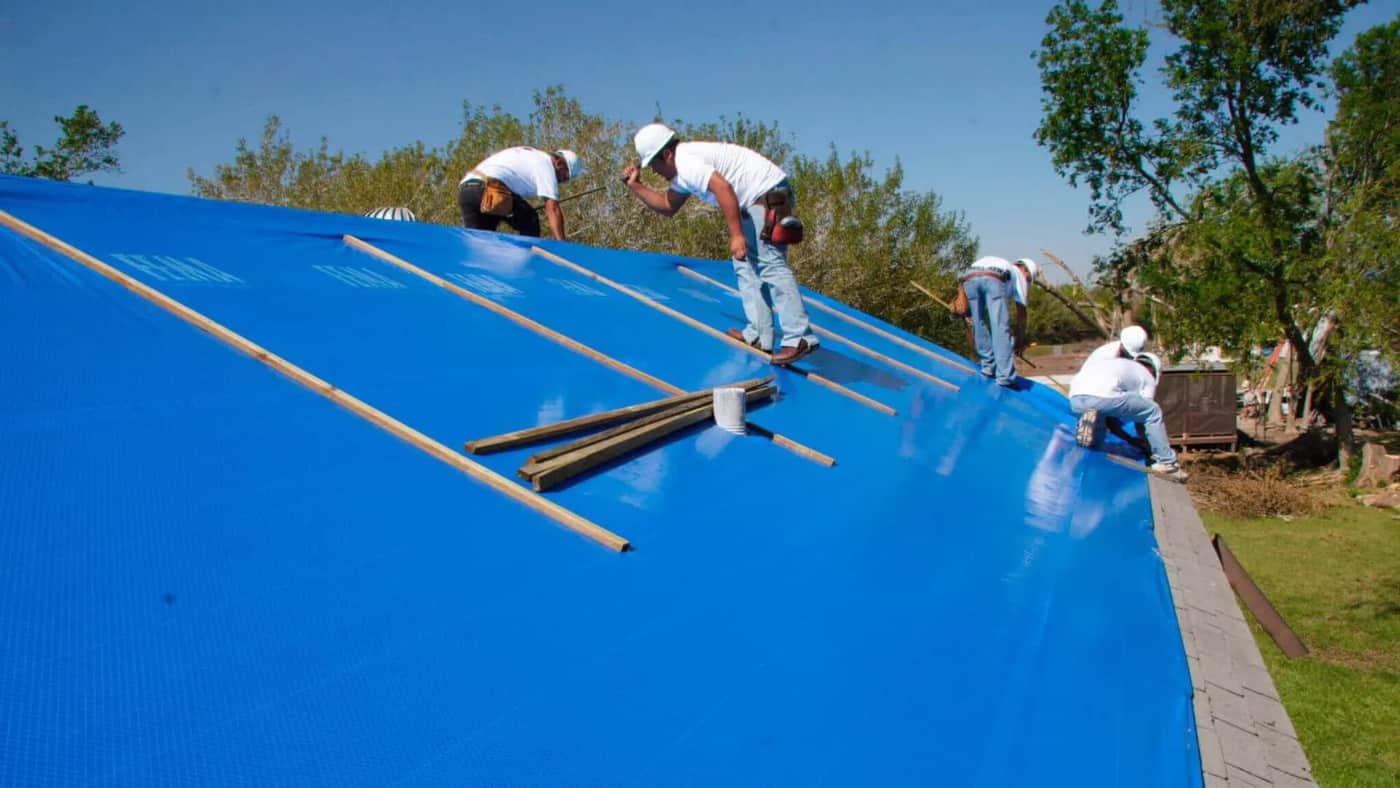
Emergency protective measures, temporary tarping on open roof areas, membrane patches over active leak points, drain clearing to prevent structural water loading, are the immediate service need after significant storm damage. We deploy emergency protective measures as quickly as possible after storm events, prioritizing buildings where ongoing water infiltration is occurring or where structural loading from ponding is a concern. Emergency protective work is documented with photographs before it begins and after it is completed, establishing the pre-protection damage condition for insurance purposes while stopping the ongoing damage. Temporary protection is not a substitute for permanent repair, and we communicate the temporary nature of emergency work clearly to property owners who may otherwise assume that tarping has fully resolved the situation.
Insurance coordination after storm damage is a service we provide throughout the claims process. Post-storm assessment reports are formatted for insurance submission. We coordinate with adjusters who need to inspect damage before permanent repairs proceed, providing roof access and technical explanation of the damage findings during adjuster visits. When adjuster scopes are narrower than the actual damage warrants, a common occurrence after major regional storm events when adjusters are handling high claim volumes, we provide written supplements with additional technical documentation. For property owners who have retained public adjusters or legal representation to manage their claims, we work with those representatives and provide the technical roofing documentation they need.
For commercial property owners who want to reduce their storm damage exposure before each season, the pre-hurricane maintenance visit is the most effective investment available. We address the conditions that storms exploit: corroded edge metal fasteners, cracked pipe boots, partially obstructed drains, failed lap sealants, and perimeter flashings that have separated from parapet walls. Buildings that arrive at storm season with these conditions corrected consistently sustain less damage than those with deferred maintenance, not because maintenance makes roofs invulnerable to major storms, but because it eliminates the marginal conditions that turn a manageable event into a significant claim.
Questions Owners Ask
How quickly can I expect a response after a storm damages my commercial roof?
Response time depends on the severity of the event and the volume of simultaneous calls from across the region. For active water intrusion into occupied buildings or critical contents, we prioritize and respond as quickly as safely possible, typically within 24 to 48 hours after a major storm event. After a regional hurricane or tropical storm, every commercial roofing contractor in the market is responding to simultaneous calls and realistic timelines extend accordingly. We communicate honestly about expected response windows rather than promising timelines we cannot meet.
My roof leaked during the storm but seems fine now that it has stopped raining. Do I still need a repair?
Yes. A roof that leaked during a storm has an active compromise, a seam failure, a cracked pipe boot, a lifted flashing, that will leak again in the next rain event. Storm conditions that trigger leaks also often reveal and worsen pre-existing marginal conditions. The fact that it has stopped leaking means only that it has stopped raining, not that the underlying condition has resolved. We recommend prompt post-storm assessment even when the immediate leak has stopped, both to identify and repair the compromise and to document the condition before it is further altered by weather.
Does storm damage repair require an insurance claim, or can I just pay for it out of pocket?
Either is your choice as the property owner. Many storm damage repairs, particularly smaller convective storm damage, fall below commercial deductible levels and are more efficiently handled as direct-pay repairs rather than insurance claims. For larger damage from named storm events, insurance claims are typically appropriate and recoverable. We provide repair cost estimates regardless of whether insurance is involved and can document the damage in the format needed for insurance submission if you choose to file a claim. There is no obligation to file a claim for any storm damage repair we perform.
How do I tell the difference between storm damage and normal wear that just became visible after a storm?
This is precisely the distinction that matters for insurance purposes, and it requires a trained eye. Fresh storm damage shows specific patterns, torn edges with fresh exposure, impact craters with crisp perimeters, displaced components with visible fresh separation. Pre-existing deterioration shows gradual degradation patterns, oxidized surfaces, progressive lap adhesive failure, corrosion through metal components over time. We document storm damage with the technical detail that clearly identifies the storm damage characteristics and distinguishes them from pre-existing conditions in the same areas.
We took storm damage at multiple properties across Brunswick and Pender counties. Can you handle all of them?
Yes. We serve commercial properties throughout the greater Wilmington metro area including New Hanover, Brunswick, and Pender counties. Portfolio owners with properties spread across the region can work with us as a single contractor for all post-storm assessment and repair needs. We triage multiple-property portfolios based on damage severity and water intrusion risk, and coordinate scheduling across all properties systematically. Having a single contractor manage post-storm work across a portfolio simplifies the logistics, insurance coordination, and documentation significantly compared to managing multiple contractors independently.